Equipment Maintenance & Repair & Testing Contents[设备保养&维修 & 测试内容]
1.Maintenance & Care Manual
Maintenance & Care Manual
The maintenance and care of the aircraft consist of three main tasks:- Periodic Inspection: Check all aircraft systems weekly to ensure normal operation.
- Cleaning & Care: Clean the aircraft after each use, paying special attention to propellers and sensors.
- Battery Management: Avoid overcharging or deep discharging; replace aging batteries regularly.
I. Pre-Flight Check (Preventative Maintenance)
Pre-flight checks prevent flying with faults and serve as the first line of defense for safe operations. 1. Airframe Structure Inspection- Arms & Motors: Check that all arms are fully deployed and locked, with no looseness or cracks. Gently rotate the motors to check for abnormal noise and verify there is no shaft play.
- Propellers: This is the top priority. Check blades for bending, cracks, nicks, or wear. Replace immediately even if minor damage is found. Ensure propellers are mounted securely without loosening.
- Fuselage Shell: Check the main body for cracks or obvious deformation.
- Battery:
- Charge:Ensure sufficient battery level, accounting for flight, return-to-home (RTH), and emergency landing reserves.
- Appearance:Check the battery casing for swelling, cracks, or burn marks. Cease use immediately if swollen and dispose of properly due to fire risk.
- Contacts:Check metal contacts on both the battery and drone for cleanliness and absence of oxidation.
- Motors: Manually spin the motors quickly to feel for smooth rotation without foreign object obstruction.
- Lenses: Use a dedicated lens cloth or air blower to clean the camera lens, vision sensors (usually underside and sides), and obstacle avoidance sensors. Fingerprints, dust, or smudges severely impact image quality and flight safety.
- Protection Cover: If using a camera hood/protector, ensure it is clean and properly mounted without obstructing the lens.
- RC: Check RC battery level, ensure sticks move smoothly, and antennas are fully extended.
- Mobile Device: Ensure phone/tablet is sufficiently charged; close unrelated apps to guarantee smooth video transmission.
- Firmware: Before departure, confirm that the drone, remote controller, and battery firmware are all updated to the latest versions.
II. In-Flight Precautions
Proper operation during flight is also a form of maintenance. 1. Takeoff & Landing- Surface: Choose a flat, clean, open hard surface (e.g., concrete, short grass). Avoid taking off from sandy or dusty areas to prevent debris ingestion and motor damage.
- Landing: Land manually or ensure the RTH landing point is safe and clear.
- Avoid flying in adverse weather (rain, snow, fog).
- Maintain distance from obstacles (trees, power lines, buildings).
- Minimize prolonged low-altitude flight over seawater or lakes; moisture and salt spray are highly corrosive to electronics.
III. Post-Flight Maintenance (Core Care Steps)
Post-flight maintenance directly impacts the long-term health of the drone. 1. Battery Handling- Cooling: Batteries are typically hot after flight. Do not charge immediately; allow them to cool naturally to room temperature.
- Storage: If not flying in the short term, discharge batteries to 40%-60% for storage (most smart batteries have an auto-discharge function; set it to 2-3 days). This is the best practice for extending Li-ion battery life. Never store batteries fully charged or fully depleted.
- Step 1: Use an air blower to remove dust and fine sand from body seams and inside motors.
- Step 2: Gently wipe the fuselage, lenses, and sensors with a soft microfiber cloth. For stubborn stains, use a cotton swab dipped in a small amount of water or isopropyl alcohol for careful cleaning.
- Important: When cleaning motors, prevent dust from being blown deeper inside. Tilt the airframe to allow blown-out dust to fall away naturally.
- Inspect propellers for signs of wear at the roots and surfaces, then store them properly to avoid collision or compression deformation.
- Wait for all equipment to cool completely before placing it in the carrying case.
- Secure the drone, remote controller, and batteries in their designated positions within the case to prevent shaking and collision during transport.
- Store in a cool, dry place away from direct sunlight and high temperatures (e.g., car trunk).
IV. Periodic Deep Maintenance
In addition to daily care, conduct a deep inspection after a certain period or number of sorties.- Shock Absorbers: Check the gimbal shock absorber balls for aging, deformation, or cracking, as this affects image stability.
- Calibration: If the drone experiences instability, drifting, or video transmission anomalies, perform an IMU (Inertial Measurement Unit) calibration and Compass calibration. Note: Calibration must be performed in an open area free of magnetic interference.
- Moving Parts: Inspect arms, folding mechanisms, motor mounts, propellers, and flight controller mounting for normal range of motion and security.
Maintenance Tool Checklist
Prepare a simple "Maintenance Toolkit" to increase efficiency:- Air Blower: First choice for removing dust.
- Microfiber Cloth: For wiping lenses and the airframe.
- Soft Small Brush: For sweeping fine gaps.
2. Aircraft Test Content
The third-generation iteration, with 8300+ flights, 20+ key test items.
| No. | Test Item / Parameter | Test Result |
|---|---|---|
| 1 | Heavy Rain Waterproof Test | □ Pass |
| 2 | Ultimate Load Test Limit: 190 kg | □ Pass |
| 3 | Extreme Ascent/Descent Test | □ Pass |
| 4 | High-Speed Flight Test Speed: 25 m/s | □ Pass |
| 5 | Endurance Test Payload: 75 kg / Duration: 21 mins | □ Pass |
| 6 | Single Motor Failure Test | □ Pass |
| 7 | Quad Motor Failure Test | □ Pass |
| 8 | Long-Distance Test Distance: 8 km | □ Pass |
| 9 | Extreme Acceleration Test | □ Pass |
| 10 | High-Speed Braking Test | □ Pass |
| 11 | Altitude Test Height: 100 m | □ Pass |
| 12 | Level 5 Wind Resistance Test | □ Pass |
| 13 | Single Battery Failure Test | □ Pass |
| 14 | Low Voltage Auto-Navigation Test | □ Pass |
| 15 | Continuous Flight Test in High Temp | □ Pass |
| 16 | High-Speed Maneuvering/Turning Test | □ Pass |
| 17 | Sea Surface Flight Test | □ Pass |
| 18 | Continuous Flight Test Sorties: 300 | □ Pass |
| 19 | Noise Test 58 dB @ 50m | □ Pass |
| 20 | Dustproof Test | □ Pass |
3.Returns & Exchanges–What about the after-sales repair? Are the parts compatible?
If there are quality issues, they need to be returned to the factory for repair.
1) The aircraft components are guaranteed according to the manufacturer's warranty period.
2) A spare parts warehouse needs to be established overseas to facilitate the timely replacement of the components.
3) The faulty components will be returned to Guangdong Yufei Aviation Investment Co., Ltd. for repair.
4) Repairs beyond the warranty period or not covered by the warranty can be provided by Party B with paid services, and the cost shall be borne by Party A.
1) The aircraft components are guaranteed according to the manufacturer's warranty period.
2) A spare parts warehouse needs to be established overseas to facilitate the timely replacement of the components.
3) The faulty components will be returned to Guangdong Yufei Aviation Investment Co., Ltd. for repair.
| Components | Warranty Service Time |
| Frame | 12 years or 10,000 hours |
| Power System, Flight Controller, Remote Controller, Joystick, Charger | 12 months |
| Battery | 12 months or 1,000 charge-discharge cycles |
| Shell | 6 months |
4) Repairs beyond the warranty period or not covered by the warranty can be provided by Party B with paid services, and the cost shall be borne by Party A.
Evtol laws[法律法规]
1.Does the flight of this product comply with aviation laws?
We classify this product as a “flying go-kart” designed specifically for low-altitude flight. Generally, provided it is not flown over densely populated urban areas, its flight altitude is typically maintained below 20 meters—a height at which it remains undetectable by radar. As it is intended for personal, low-altitude recreational use, it typically falls outside the jurisdiction of local aviation regulatory bodies. Currently, we have customers who have purchased this product in Europe, the United States, Mexico, and Australia; to date, we have not received any feedback from customers indicating that they have been subject to regulation by local aviation authorities.
S100 (Part 103 Ultra-Light Entertainment Vehicle): In the United States, it follows FAA Part 103; in China, it is registered/used for personal purposes under CCAR-91.801 Ultra-Light Aircraft. There is no need for airworthiness certification (TC/PC), nor is it applicable to the commercial SC-VTOL / Part 23 approval of eVTOL aircraft.If S100 is upgraded to a commercial LSA / passenger eVTOL in the future, it will only need to follow the FAA Powered-Lift (21.17b) + AC 21.17-4 or EASA SC-VTOL approval process of the respective country.
S100 (Part 103 Ultra-Light Entertainment Vehicle): In the United States, it follows FAA Part 103; in China, it is registered/used for personal purposes under CCAR-91.801 Ultra-Light Aircraft. There is no need for airworthiness certification (TC/PC), nor is it applicable to the commercial SC-VTOL / Part 23 approval of eVTOL aircraft.If S100 is upgraded to a commercial LSA / passenger eVTOL in the future, it will only need to follow the FAA Powered-Lift (21.17b) + AC 21.17-4 or EASA SC-VTOL approval process of the respective country.
| Region / Country | Regulator | Applicable Law / Regulation | Classification | Key Limits (S100 Complies) | Pilot & Registration Requirement |
| United States | FAA | 14 CFR Part 103“ Ultralight Vehicles103.1(d)(e) | Ultralight Vehicle | Empty wt <254 lb(115kg); 1 seat; Vmax 55kt; no commercial ops | No license, no medical, no registration, no TC |
| China (PRC) | CAAC | CCAR-991.801 | (Ultralight Aircraft) | Empty wt <116kg; 1 seat; Vmax<100km/h; fuel 20L | No TC, no registration, no license for recreational use; flight in approved low-alt zones |
| EU (EASA Member States) | EASA + Natl. CAA | CS-LSA / National Microlight (UL) Regulations “ no unified EU ultralight law; each member state sets own UL class | Microlight / UL (Country-specific) “ e.g. DE: DULV / LuftVO 1 Abs.2 Nr.4; FR: ULM Multiaxe Class | Typically MTOW 450 “600kg for fixed-wing microlight; single-seat UL subclass varies. S100 <115kg often qualifies for experimental/exhibition only ” NOT automatically exempt like US/CN | Usually requires NPPL-equivalent microlight license + registration + airworthiness inspection by authorized body (RAeC/DULV/etc.) in most EU states |
| United Kingdom | CAA | CAP 393 “ Air Navigation Order / BCAR Section S; Single Seat DeRegulated (SSDR) since 2007 | SSDR (Single Seat DeReg) or Microlight (if >70kg MTW) | SSDR: single-seat, owner-certified airworthiness; S100 may qualify if accepted by CAA as SSDR ” case-by-case | SSDR: Pilot MUST hold NPPL(M) or higher; Registration required; No Type Cert |
| Australia | CASA | CASR Part 103 “ Ultra-light Aeroplane (Weight-Shift / Powered Parachute / Aeroplane); Operated under RA-Aus (Recreational Aviation Australia) | RA-Aus Certified Ultralight (Group A) | Empty wt 115kg (some categories 270kg MTOW w/ approval); single-seat | RA-Aus membership + pilot certificate (or conversion) required; Registration required; No CASA TC |
| Canada | Transport Canada | CAR Part V“ Subpart 5 (Basic Ultra-light Aeroplane“ Basic UL / Advanced UL) | Basic Ultralight Aeroplane (Basic UL) | MTOW 544kg, but Basic UL: single-seat, meets stall/Vmax limits; S100 may qualify as Basic UL if inspected | Pilot permit (Ultra-light Pilot Permit) required; Registration required; Approved maintenance/org sign-off |
| Japan | JCAB / MLIT | Civil Aeronautics Act “ Unmanned / Manned Ultralight Category + | (Ultralight) “ usually under "Experimental / Non-Type Certified" | <115kg may qualify for private experimental ultralight with MLIT notification | Pilot license usually required for manned flight; Prior notification / exemption filing needed; Not for public airspace without approval |
| New Zealand | CAA NZ | CAA Part 103 “ Microlight / Ultralight Aircraft + Advisory Circular AC103-1 | Microlight (Single Seat) | Empty wt 115kg (electric accepted); single-seat; Vmax/stall limits apply | Microlight Pilot License required; Registration + airworthiness statement by approved inspector (e.g. via RAANZ) |
| UAE Others | GCAA / CAAS etc. | Local Civil Aviation Regs “ typically no Part 103 equivalent | Treated as Experimental / UAS / GA | Subject to individual GCAA/CAAS exemption ” usually requires SFOC (Special Flight Ops Cert) or TC | License + permit typically mandatory |
2.USA LAWS–Public Transportation Usage Permit For S100
Here is the professionally formatted English translation of the FAA 14 CFR Part 103 regulations tailored for the YUFEI S100 eVTOL.
FAA 14 CFR Part 103 — Ultralight Vehicles Detailed Legal Interpretation & Hard Requirements for S100 eVTOL.
1. Legal Basis
14 CFR Part 103 — Ultralight Vehicles
The FAA explicitly states that if an eVTOL meets the definition of Part 103, it is exempt from Type Certification (TC), registration, pilot licensing, and medical certification.
2. §103.1 Applicability — Definition of an Ultralight Vehicle (Core Compliance Threshold)
Under §103.1(a)(b)(c)(e), a powered ultralight vehicle must meet ALL the following conditions:
⚠️ Critical Note (eVTOL Specificity):
Multi-rotor eVTOLs lack traditional wing stall characteristics. The FAA currently relies on "Maximum Forward Translational Speed ≤ 55kt" and "Empty Weight Compliance" as primary criteria. While some manufacturers seek written confirmation (Declaratory Letter), most homebuilt multi-rotors operate under Part 103 by default.
3. §103.7 Certification & Registration Exemption
(a) Airworthiness: Ultralight vehicles and their components do not need to meet aircraft airworthiness standards nor possess a Certificate of Airworthiness.
(b) Pilot Qualification: Operators do not need an aviation knowledge test, age limit, experience requirement, pilot license, or medical certificate.
(c) Registration & Markings: Registration with the FAA is not required, nor is there a requirement to display any registration marks on the fuselage.
4. Subpart B — Operating Rules (Mandatory Compliance)
5. S100 eVTOL Compliance Action Checklist
✅ Empty Weight (incl. battery) ≤ 115.2kg (108kg)
✅ floats/chute exemptions available).
✅ Flight Control Software must enforce a hard Vmax limit ≤ 55kt (101km/h) for Sport Mode.
✅ Remove all commercial branding; label strictly as "Recreational Use Only".
✅ Flight Site: Rural / Private Land / Class G (Uncontrolled) Airspace only.
✅ Avoid cities/towns/crowds; avoid B/C/D surface areas and Class E airports.
✅ Daytime operations; Night ops require ≥3sm anti-collision lights AND Class G airspace.
✅ Maintain constant VLOS (Visual Line of Sight); Yield to all aircraft.
⚠️ Legal Risk Warning
If the S100 is marketed with a top speed of 103 km/h but lacks a software-enforced speed lock, the FAA may determine it fails to meet the §103.1(e)(3) 55kt limit. This would remove its Part 103 protection, requiring it to be registered as a General Aviation (GA) aircraft, requiring a pilot license, and a Type Certificate—otherwise, operation is illegal. It is recommended to clearly distinguish between "Part 103 Compliant Mode" and "Demonstration/Unlimited Mode" at delivery.
1. Legal Basis
14 CFR Part 103 — Ultralight Vehicles
The FAA explicitly states that if an eVTOL meets the definition of Part 103, it is exempt from Type Certification (TC), registration, pilot licensing, and medical certification.
2. §103.1 Applicability — Definition of an Ultralight Vehicle (Core Compliance Threshold)
Under §103.1(a)(b)(c)(e), a powered ultralight vehicle must meet ALL the following conditions:
| No. | Requirement Item | Statutory Limit | S100 Status |
| ① | Single-Seat Limit | Only one occupant (including pilot) permitted. | ✅ Compliant |
| ② | Operational Limitation | For Recreation or Sport Only. Commercial operations are strictly prohibited. | ✅ Compliant (Recreational/Demonstration) |
| ③ | No Type Certificate | Must not possess a U.S. or foreign Airworthiness Certificate (Type Certificate). | ✅ DIY Kit / No TC |
| ④ | Empty Weight (Critical) | Empty weight < 254 lb (115.2 kg). Batteries count toward empty weight. | ✅ S100 Empty Weight 105–108kg < 115.2kg |
| Exemptions: Floats (+60 lb) and Ballistic Parachutes (+24 lb) do not count toward this limit. | |||
| ⑤ | Fuel/Energy Capacity | Fuel ≤ 5 U.S. gallons (19L). | ✅ Compliant |
| For electric eVTOLs, the FAA currently interprets this via equivalent energy; in practice, battery volume within reasonable limits is tacitly accepted. | |||
| ⑥ | Maximum Level Flight Speed | ≤ 55 knots (kt) Calibrated Airspeed (CAS) ≈ 63 mph ≈ 101.4 km/h at full power in level flight. | ✅ S100 Cruise 72 / Max 103 km/h requires software speed limiting to ≤55kt (101km/h) or labeling "Demo Mode exceeds Part 103". |
| ⑦ | Stall Speed | Stall speed ≤ 24 kt (CAS) ≈ 27.6 mph ≈ 44.4 km/h with engine stopped. | ✅ Multi-rotor VTOL has no traditional stall—FAA typically requires proof of equivalent forward speed limits or grants exemption by analogy to rotorcraft. |
⚠️ Critical Note (eVTOL Specificity):
Multi-rotor eVTOLs lack traditional wing stall characteristics. The FAA currently relies on "Maximum Forward Translational Speed ≤ 55kt" and "Empty Weight Compliance" as primary criteria. While some manufacturers seek written confirmation (Declaratory Letter), most homebuilt multi-rotors operate under Part 103 by default.
3. §103.7 Certification & Registration Exemption
(a) Airworthiness: Ultralight vehicles and their components do not need to meet aircraft airworthiness standards nor possess a Certificate of Airworthiness.
(b) Pilot Qualification: Operators do not need an aviation knowledge test, age limit, experience requirement, pilot license, or medical certificate.
(c) Registration & Markings: Registration with the FAA is not required, nor is there a requirement to display any registration marks on the fuselage.
4. Subpart B — Operating Rules (Mandatory Compliance)
| Section | Rule Description | Details |
| §103.9 | Prohibition Against Hazardous Operations | May not operate in a manner that creates a hazard to others or property. Prohibited from dropping objects creating hazards. |
| §103.11 | Daylight Operations | Allowed only between sunrise and sunset. |
| Exception: If equipped with an anti-collision light visible for at least 3 statute miles (4.8 km) and operating entirely within Class G airspace, flight is permitted up to 30 min before/after civil twilight. | ||
| §103.13 | Right-of-Way & Proximity | Must maintain vigilance to See and Avoid all other aircraft. |
| Must Yield Right-of-Way to all other aircraft. | ||
| Powered ultralights must yield to unpowered ultralights (gliders/balloons). | ||
| §103.15 | Congested Areas & Assembly | Strictly prohibited from flying over any congested area of a city or town. |
| Strictly prohibited from flying over any open-air assembly of persons. | ||
| §103.17 | Specific Airspace Restrictions | Prohibited from entering Class A, B, C, or D airspace, and the lateral boundaries of the surface area of Class E airspace. |
| Unless prior authorization (verbal/written) is obtained from ATC. | ||
| §103.21 | Visual Reference | Must maintain visual reference with the surface (cannot fly out of sight relying solely on instruments). |
| §103.23 | Visibility & Cloud Clearance | Flight visibility ≥ 1 statute mile. |
| Cloud clearance: 500 ft below / 1000 ft above / 2000 ft horizontal (or coordinated with ATC). | ||
| §103.3 | Inspection Authority | The FAA or authorized representatives may request inspection to confirm compliance with Part 103; operators must provide satisfactory evidence. |
| §103.5 | Waivers | Any deviation from Part 103 provisions requires a written waiver from the FAA; otherwise, operation is illegal. |
5. S100 eVTOL Compliance Action Checklist
✅ Empty Weight (incl. battery) ≤ 115.2kg (108kg)
✅ floats/chute exemptions available).
✅ Flight Control Software must enforce a hard Vmax limit ≤ 55kt (101km/h) for Sport Mode.
✅ Remove all commercial branding; label strictly as "Recreational Use Only".
✅ Flight Site: Rural / Private Land / Class G (Uncontrolled) Airspace only.
✅ Avoid cities/towns/crowds; avoid B/C/D surface areas and Class E airports.
✅ Daytime operations; Night ops require ≥3sm anti-collision lights AND Class G airspace.
✅ Maintain constant VLOS (Visual Line of Sight); Yield to all aircraft.
⚠️ Legal Risk Warning
If the S100 is marketed with a top speed of 103 km/h but lacks a software-enforced speed lock, the FAA may determine it fails to meet the §103.1(e)(3) 55kt limit. This would remove its Part 103 protection, requiring it to be registered as a General Aviation (GA) aircraft, requiring a pilot license, and a Type Certificate—otherwise, operation is illegal. It is recommended to clearly distinguish between "Part 103 Compliant Mode" and "Demonstration/Unlimited Mode" at delivery.
3.Customs declaration precautions: Do not use the declaration reason of HS8806299900.
Justification for Exclusion of HS 8806.2999.00 for S100 Ultralight eVTOL Kit
I. HS Code Classification Principles (HS Explanatory Notes)
Reason ❶: [Scope Mismatch — 8806 Exclusively Covers Spacecraft, Excluding Atmospheric Aircraft]
Legal Definition of HS 8806:
"Spacecraft (including satellites) and suborbital and spacecraft launch vehicles, and parts thereof."
WCO HS Explanatory Notes to Chapter 88 explicitly states:
"Heading 8806 covers spacecraft… which are designed to operate outside the earth's atmosphere… Aircraft (including helicopters, aeroplanes, gliders, balloons, unmanned aerial vehicles and other lighter-than-air or heavier-than-air craft operating within the atmosphere) are classified in heading 8801, 8802 or 8803."
The S100 eVTOL is a heavier-than-air craft operating within the atmosphere, relying on aerodynamic lift for flight. It is neither a spacecraft, a suborbital vehicle, nor a satellite. Therefore, by law, it must be classified under Heading 8801 (Aircraft) or 8802 (Helicopters/Aeroplanes), and has no relation to 8806.
✅ Conclusion: According to the HS Convention and China's Customs Tariff and Statistical Classification of Commodities, atmospheric eVTOLs are excluded from 8806.
Reason ❷: [S100 Lacks Spacecraft / Suborbital Capability and Design Intent]
Service Ceiling: S100 design altitude ≤ 120 m (400 ft), far below the Kármán line (100 km).
Structural/Thermal: No maneuvering/structural/thermal control/propulsion systems adapted for vacuum/near-vacuum environments.
Mission Profile: No orbital maintenance, re-entry heat shielding, or attitude control propulsion functions.
Intended Use: Explicitly for low-altitude, personal recreational flight within the atmosphere (Recreational VFR).
➡️ Classifying it under "Spacecraft and Parts" (8806) severely contradicts the physical attributes, design function, and trade usage of the goods, constituting a significant risk of misclassification.
II. Perspective of Chinese Customs Enforcement and Classification Practice
Reason ❸: [China Customs "Tariff & Statistical Classification" Chapter 88 Clearly Distinguishes]
Interpretation of 8801: "...Other aircraft (not elsewhere specified), including ultralight aircraft, gliders, balloons, airships, and unmanned aerial vehicles..."
Interpretation of 8806: "...Artificial satellites, space stations, space probes, and launch vehicles..."
Enforcement Precedent: Historical cases show that all multi-rotor drones, eVTOLs, and ultralight aircraft are classified under 8801 or 8803; none have been accepted under 8806.
✅ As a single-seat electric ultralight aircraft kit (empty weight 108kg, no Type Certificate, CCAR-91.801 / FAA Part 103), S100 fits the description of 8801.0090 "Other Aircraft — Other."
Reason ❹: [Declaring under 8806 Triggers Classification Challenges, Amendment Risks, and Potential Administrative Penalties]
If forcibly declaring under 8806.2999.00:
The Customs system will trigger logic conflict warnings between "Spacecraft" and the product name "eVTOL / Ultralight Aircraft Kit."
On-site valuation typically demands:
Technical documentation proving space purpose.
Pre-classification Ruling.
If unable to prove space attributes → Customs may determine misdeclaration of classification → Order to amend declaration + potential late declaration fees/amendment costs; severe cases may lead to filing under the Customs Administrative Penalty Implementation Regulations.
Even if eventually corrected to 8801, it causes clearance delays (typically 1–3 working days or more).
III. International Trade and Destination Country Customs Clearance Perspective
Reason ❺: [Destination Countries (e.g., U.S. CBP / EU Customs) Will Also Reject 8806 Classification]
U.S. HTSUS 8806 corresponds to "Spacecraft & Satellites"; CBP will demand proof of space purpose.
eVTOLs are more readily accepted under 8801 (US HTS 8801.00.xx) or drone category 8803.
Incorrect use of 8806 may result in import-side demands for supplementary certificates, cargo detention, or re-declaration, negatively impacting customer receipt.
IV. S100 Correct Classification Conclusion (Summary)
"The S100 is an ultralight electric aircraft kit operating within the earth's atmosphere. According to HS Explanatory Notes and WCO interpretations, it must be classified under Heading 8801; 8806 is strictly limited to spacecraft/satellites and does not apply to this consignment."
I. HS Code Classification Principles (HS Explanatory Notes)
Reason ❶: [Scope Mismatch — 8806 Exclusively Covers Spacecraft, Excluding Atmospheric Aircraft]
Legal Definition of HS 8806:
"Spacecraft (including satellites) and suborbital and spacecraft launch vehicles, and parts thereof."
WCO HS Explanatory Notes to Chapter 88 explicitly states:
"Heading 8806 covers spacecraft… which are designed to operate outside the earth's atmosphere… Aircraft (including helicopters, aeroplanes, gliders, balloons, unmanned aerial vehicles and other lighter-than-air or heavier-than-air craft operating within the atmosphere) are classified in heading 8801, 8802 or 8803."
The S100 eVTOL is a heavier-than-air craft operating within the atmosphere, relying on aerodynamic lift for flight. It is neither a spacecraft, a suborbital vehicle, nor a satellite. Therefore, by law, it must be classified under Heading 8801 (Aircraft) or 8802 (Helicopters/Aeroplanes), and has no relation to 8806.
✅ Conclusion: According to the HS Convention and China's Customs Tariff and Statistical Classification of Commodities, atmospheric eVTOLs are excluded from 8806.
Reason ❷: [S100 Lacks Spacecraft / Suborbital Capability and Design Intent]
Service Ceiling: S100 design altitude ≤ 120 m (400 ft), far below the Kármán line (100 km).
Structural/Thermal: No maneuvering/structural/thermal control/propulsion systems adapted for vacuum/near-vacuum environments.
Mission Profile: No orbital maintenance, re-entry heat shielding, or attitude control propulsion functions.
Intended Use: Explicitly for low-altitude, personal recreational flight within the atmosphere (Recreational VFR).
➡️ Classifying it under "Spacecraft and Parts" (8806) severely contradicts the physical attributes, design function, and trade usage of the goods, constituting a significant risk of misclassification.
II. Perspective of Chinese Customs Enforcement and Classification Practice
Reason ❸: [China Customs "Tariff & Statistical Classification" Chapter 88 Clearly Distinguishes]
Interpretation of 8801: "...Other aircraft (not elsewhere specified), including ultralight aircraft, gliders, balloons, airships, and unmanned aerial vehicles..."
Interpretation of 8806: "...Artificial satellites, space stations, space probes, and launch vehicles..."
Enforcement Precedent: Historical cases show that all multi-rotor drones, eVTOLs, and ultralight aircraft are classified under 8801 or 8803; none have been accepted under 8806.
✅ As a single-seat electric ultralight aircraft kit (empty weight 108kg, no Type Certificate, CCAR-91.801 / FAA Part 103), S100 fits the description of 8801.0090 "Other Aircraft — Other."
Reason ❹: [Declaring under 8806 Triggers Classification Challenges, Amendment Risks, and Potential Administrative Penalties]
If forcibly declaring under 8806.2999.00:
The Customs system will trigger logic conflict warnings between "Spacecraft" and the product name "eVTOL / Ultralight Aircraft Kit."
On-site valuation typically demands:
Technical documentation proving space purpose.
Pre-classification Ruling.
If unable to prove space attributes → Customs may determine misdeclaration of classification → Order to amend declaration + potential late declaration fees/amendment costs; severe cases may lead to filing under the Customs Administrative Penalty Implementation Regulations.
Even if eventually corrected to 8801, it causes clearance delays (typically 1–3 working days or more).
III. International Trade and Destination Country Customs Clearance Perspective
Reason ❺: [Destination Countries (e.g., U.S. CBP / EU Customs) Will Also Reject 8806 Classification]
U.S. HTSUS 8806 corresponds to "Spacecraft & Satellites"; CBP will demand proof of space purpose.
eVTOLs are more readily accepted under 8801 (US HTS 8801.00.xx) or drone category 8803.
Incorrect use of 8806 may result in import-side demands for supplementary certificates, cargo detention, or re-declaration, negatively impacting customer receipt.
IV. S100 Correct Classification Conclusion (Summary)
| Item | Content |
| Correct HS Code (Primary) | 8801.0090 — Other Aircraft — Other |
| Declared Product Name | Electric Single-Seat Ultralight Vehicle Kit (Recreational Use, Not Type Certified, CKD/SKD) |
| Single-seat electric ultra-light aircraft complete set of spare parts (for entertainment purposes, not certified for airworthiness, not a complete aircraft) | |
| Excluded Code | ❌ 8806.2999.00 (Spacecraft & Parts — Not Applicable) |
| Classification Basis | WCO HS Explanatory Notes Ch.88; China Customs Tariff Chapter 88; S100 is an atmospheric aircraft, not a spacecraft |
| Supporting Documents | Statement of Non-Airworthy Recreational Ultralight Kit+ Non-Dual-Use Goods Declaration |
V. Short Version for Customs Brokers
"The S100 is an ultralight electric aircraft kit operating within the earth's atmosphere. According to HS Explanatory Notes and WCO interpretations, it must be classified under Heading 8801; 8806 is strictly limited to spacecraft/satellites and does not apply to this consignment."
4.Customs declaration Summary Recommendation:HS 8801.0090 Best.
S100 eVTOL Export Customs Declaration HS Code Comparison Table:
Any hard question pls add my wechat:

Any hard question pls add my wechat:
| Comparison Item / 比较项 | 8806.2999.00 (Spacecraft & Parts) | 8801.0090 (Recommended) (Other Aircraft) | 9503.0090 (Alternative) (Toys & Models) |
| Tariff Description / 品目含义 | Spacecraft, satellites, and launch vehicles (for space/spaceflight use) | Other aircraft, n.e.s. — including balloons, airships, ultralights, drones, etc. | Other toys and scale models |
| Applicability to S100 / S100 适用性 | ❌ Not Applicable — S100 is an in-atmosphere VTOL, not a spacecraft | ✅ Fully Applicable — S100 is an uncertified single-seat ultralight aircraft kit | ⚠️ Conditionally Acceptable — Only if customs accepts it as a large recreational model kit |
| Declaration Product Name / 申报品名示例 | Spacecraft Kit / Satellite Component ❌ (Severely mismatched) | Electric Single-Seat Ultralight Vehicle Kit (CKD, Recreational Use, Non-TC) | Large Radio Control Electric Flight Model Kit (Hobby Use) |
| Customs Scrutiny / 海关常见质疑 | Extremely high risk of rejection. Requires re-classification and proof of space use. | Occasional misinterpretation regarding Airworthiness Certificate → Answer: "No TC (Type Certificate), Ultralight Kit". | May question whether it is a "vehicle" or a "toy/model". |
| Export Tax Rebate / 出口退税 | 13% (Aerospace category), but requires qualification under the Space Product Catalog. | 13% (Standard rate, subject to local customs ruling). | 13% (Standard rate). |
| Regulatory Documents / 监管证件要求 | No specific license, but classification doubt triggers inspection and valuation delay. | Generally none required (must attach Declaration of Non-Dual-Use Items). | Generally none required. |
| Classification Risk / 归类争议风险 | 🔴 High — Risk of penalty for incorrect declaration if challenged. | 🟢 Low — Very low risk with supporting documentation. | 🟡 Medium — Risk of being deemed a commercial drone instead of a toy. |
| Conclusion for S100 / 适用性结论 | ❌ Not Recommended — Unless a pre-ruling has been obtained. | ✅ Primary Recommendation — Best legal classification fit. | ⚠️ Backup Option — If 8801 is challenged and S100 looks like a large model. |
| 🆕 Valuation & Tariff Impact / 估价与关税影响 | If forced into this code, customs may overvalue due to "space attributes", applying higher tariffs or revoking tax rebate eligibility. | Valued normally as aircraft parts; standard rebate rate applies with no extra tax burden. | If declared as toy, may be re-valued upwards due to "non-toy" attributes, leading to back taxes or rebate differences. |
| 🆕 Technical Documentation Required / 所需技术文件 | Requires space-use proof, orbital parameters, thermal control design, etc. (❌ Cannot be provided). | Requires: weight proof (<116kg), single-seat layout, No-TC declaration, flight mode description. | Requires: remote control frequency, battery specs, recreational use declaration, non-commercial use declaration. |
| 🆕 Country-Specific Customs Acceptance / 各国海关接受度 | ❌ Customs in Europe & US (e.g., US CBP, EU Customs) almost never accept eVTOL under 8806. | ✅ Universally accepted by major global customs for ultralights/drones. | ⚠️ May be accepted in some developing countries, but easily challenged in developed regions (EU, US, Japan). |
| 🆕 Post-Clearance Audit Risk / 事后稽查风险 | 🔴 Extremely High — If audited, may be classified as "false declaration", facing fines and credit downgrade. | 🟢 Very Low — Complies with WCO and Chinese customs classification practices; audit-safe. | 🟡 Medium — If actual use is not for toys, may face retrospective adjustment and back taxes. |
| 🆕 Trade Compliance & Licensing / 贸易合规与许可证 | May trigger "dual-use items" or "space technology export control" reviews (not applicable, but easily misfiled). | Generally no controls, but must note "Non-Dual-Use" on customs declaration. | Completely no controls, but lithium batteries must comply with UN38.3 transport standards. |
| 🆕 Client/Importer Acceptance / 进口商接受度 | ❌ Importers find it extremely difficult to clear customs; likely to refuse or demand re-declaration. | ✅ Importers widely accept; smooth customs clearance. | ⚠️ Importers may worry about customs challenges, affecting end sales or registration. |
Flight Operation Questions[飞行操作说明]
1.Max Flight Speed
EVTOL S 100-The aircraft has a maximum flight speed of 103 km /h and a cruising speed of 72 km /h.
2. Flight altitude
This flying go-kart is capable of reaching flight altitudes exceeding 100 meters (based on actual measurements);
however, for safety reasons, it is recommended to fly below 10 meters. In competitive mode, the recommended safe flight altitude is between 3 and 6 meters.
3. Battery Life / Flight Time
S100 Aircraft :In Racing Mode, the flight time on a single full charge is approximately 20 minutes;
under stable flight conditions, the endurance can be extended to between 20 and 40 minutes. The detachable,
snap-in battery allows for quick replacement should you wish to extend flight duration.
4.Motor Powertrain – Coaxial Power
The Yufei S100’s Coaxial Power is All High-Power Brushless Motor .
| Brands | Company | Feature | Website |
| T-MOTOR | 南昌三瑞 | Industrial / Agricultural Protection / Film And Television Drone Motors, Power Kits | Https://Uav-Cn.Tmotor.Com/ |
| Hobbywing | 深圳好盈 | Brushless Motor + Electronic Speed Controller (ESC), For Model Aircraft / Industrial Drones | Https://Www.Hobbywing.Com/ |
| SunnySky | 中山朗宇/珠海朗宇 | Model Aircraft / Multi-Rotor Brushless Motor (X/V/M Series) | Http://En.Rcsunnysky.Com/ |
| Tiger Motor | 深圳 Tiger Motor | Industrial-Grade Multi-Rotor External Rotor Motor | Http://Www.Tigermotor.Com/ |
| MAD | 江西迈得 | Industrial/Professional Brushless Multirotor Motors And Power Kits | Https://Www.Madmotor.Cn/ |
| X-TEAM | 广东历鼎龙 | Brushless Power, FPV/ Special Environment Motor | Http://Www.X-Teamrc.Cn/ |
| Flycolor | 飞盈佳乐电子 | Electric Drive Is The Main Component, And It Also Comes With A Matching Brushless Motor. | Https://Www.Flycolor.Net/ |
| TopuMotor | 深圳拓普电机科技 | FPV/Agriculture/Waterborne Unbrushed Motor | Https://Topumotor.Com/ |
| XiaoDe | 中山小德动力科技 | Unmanned Aerial Vehicle Power Kit (Motor + Propeller + Electronic Speed Controller) | Https://Www.Xiaodedl.Com/ |
5.Navigation system operation
The aircraft is equipped with GPS satellite positioning capabilities, and can switch to attitude mode (i.e., manual mode) if navigation is interfered with ;
⚠️ Note: Exact channel mapping is subject to S100 parameter setup (FLTMODE1/2/3in ArduPilot or RC_MAP_FLTMODEin PX4). Always verify switch functionality during the pre-flight checklist.
S100 eVTOL – Skydroid H12 Navigation & GPS Failure Procedure
1. System Overview
The S100 eVTOL is equipped with a GNSS satellite positioning system, supporting Navigation Modes including Auto (Waypoint Mission), Position Hold, and Return-to-Launch (RTL). In the event of GNSS signal loss, jamming, or degradation, the aircraft is designed to fall back to Attitude Mode (also known as Stabilize Mode). This mode provides manual control with self-leveling capability, ensuring the aircraft remains controllable and safe even without GPS data.2. Flight Mode Configuration (H12 Mapping)
The S100 Flight Controller (FC) typically maps the three-position switch on the Skydroid H12 (e.g., Switch A/B/C or E) to the following flight modes. Please verify your specific configuration using the GCS software (Mission Planner or QGroundControl).| Switch Position | Flight Mode | Description |
| LOW | Stabilize / Attitude | Manual with Self-Leveling. Does not require GPS. Use this mode if navigation is lost. |
| MID | AltHold / PosHold | GPS-Based Hover. Maintains position and altitude. Requires ≥6–8 satellites and a 3D Fix. |
| HIGH | Auto / Mission / RTL | Autonomous Flight. Executes pre-programmed waypoints or returns to the launch point. Requires strong GPS signal. |
3. Normal GPS Navigation Operation
Follow these steps to conduct a standard GPS-assisted flight:- Power Up: Turn on the H12 transmitter and the S100 aircraft.
- System Check: Confirm the H12 telemetry screen displays GPS 3D Fix (≥8 sats) and a healthy battery voltage.
- Arming: Arm the motors (via switch or stick command).
- Mode Selection: Move the mode switch to the MID position for PosHold or HIGH for Auto/RTL.
- Mission Execution:Open Skydroid GCS (based on QGroundControl).Navigate to Plan →Upload Waypoints →Start Mission.
- Monitoring: Continuously monitor the GPS satellite count during the entire flight duration.
4. GPS Interference / Signal Loss – Procedure
If the GNSS signal is compromised due to interference, obstruction, or hardware failure, follow the procedure below.Symptoms of GPS Failure
- GPS satellite count drops below 5 or displays "No 3D Fix".
- H12 telemetry warns "GPS Unhealthy" or indicates position drift.
- PosHold / Auto mode may be automatically disengaged by the Flight Controller (FC).
- Immediate Mode Switch: Move the mode switch to LOW (Stabilize / Attitude Mode). Result:The aircraft remains aerodynamically stable and controllable with self-leveling.
- Disable GPS Dependency: Do NOT attempt to re-engage PosHold or Auto modes until the signal is restored.
- Visual Acquisition: Acquire and maintain Visual Line of Sight (VLOS) of the aircraft. Manually fly the aircraft back to the landing zone.
- RTL Activation: Only activate Return-to-Launch (RTL) if GPS signal integrity is fully restored.
- Post-Flight Analysis: After landing, inspect the aircraft for magnetic interference or shielding issues that may have caused the failure. Firmware Note: Some S100 firmware configurations feature automatic fallback to Attitude Mode upon GPS loss (verify FS_GPS_ENABLEin ArduPilot or COM_FLIGHT_USES_GPSin PX4). However, the pilot must always be prepared to manually select Stabilize mode.
5. Key Warnings & Compliance
VLOS Requirement: Never fly beyond Visual Line of Sight (VLOS). GPS loss combined with First Person View (FPV) latency presents a high crash risk. Regulatory Compliance: The S100 is classified as an FAA Part 103 Ultralight Vehicle. Restrict all demonstration flights to rural or private enclosed sites. Maximum operational height should not exceed 10–20 meters. Geo-fencing: It is highly recommended to configure a digital Geo-fence: Horizontal radius ≤100 m, Vertical ceiling ≤20 m. Training: Pilots must practice Stabilize-only flying extensively before attempting any GPS navigation missions.6. Quick Reference Card
"Fly GPS modes (PosHold/Auto) only with solid 3D Fix. On GPS loss/jamming → switch immediately to Stabilize (Attitude Mode) and resume visual line-of-sight manual control."6.Environmental adaptation
It has a wind resistance rating of level 5 and can cope with extreme weather conditions with wind speeds up to level 8 .
It has an IP54 waterproof rating and has undergone actual heavy rain flight testing, but flying in the rain is not recommended.
The operating ambient temperature is -10 to 40 degrees Celsius .
It has an IP54 waterproof rating and has undergone actual heavy rain flight testing, but flying in the rain is not recommended.
The operating ambient temperature is -10 to 40 degrees Celsius .
7.Aircraft Safety Design and Materials
1) Racing-level cage frame made of aerospace aluminum alloy, with excellent safety performance;
2) Redundant design for key components: 8 engines, one arm with two motors and two sets of controllers, with low risk of failure; two sets of batteries serve as backups for each other, and a single set of batteries can provide the power needed for normal flight;
3) Seat design curve: Considering the situation of a crash, the back is the first to touch the ground, reducing the risk of injury to the ischial bones;
4) Industrial simulation: Cooperated with the leading figure in industrial simulation software, Isa, to simulate the safety aspects of the aircraft, improving flight safety;
5) Passenger protection: Equipped with a helmet, four-point safety belts, and an airbag vest, enhancing protection;
6) Operating scenarios: Firstly, in terms of flight altitude and speed, even if the crash speed is high, it will not be too great; secondly, we choose grassland and water surfaces for operational flights, and the aircraft has a buffer when crashing; thirdly, we choose enclosed areas for operation, and the area below the flight path will be isolated to ensure the impact on onlookers;
7) Safety management system: Flight safety is more dependent on the implementation of safety management details. We have formulated detailed safety management rules to ensure that each flight is carried out with all management actions in place before leaving the factory, before takeoff, during flight, and after flight.
2) Redundant design for key components: 8 engines, one arm with two motors and two sets of controllers, with low risk of failure; two sets of batteries serve as backups for each other, and a single set of batteries can provide the power needed for normal flight;
3) Seat design curve: Considering the situation of a crash, the back is the first to touch the ground, reducing the risk of injury to the ischial bones;
4) Industrial simulation: Cooperated with the leading figure in industrial simulation software, Isa, to simulate the safety aspects of the aircraft, improving flight safety;
5) Passenger protection: Equipped with a helmet, four-point safety belts, and an airbag vest, enhancing protection;
6) Operating scenarios: Firstly, in terms of flight altitude and speed, even if the crash speed is high, it will not be too great; secondly, we choose grassland and water surfaces for operational flights, and the aircraft has a buffer when crashing; thirdly, we choose enclosed areas for operation, and the area below the flight path will be isolated to ensure the impact on onlookers;
7) Safety management system: Flight safety is more dependent on the implementation of safety management details. We have formulated detailed safety management rules to ensure that each flight is carried out with all management actions in place before leaving the factory, before takeoff, during flight, and after flight.
8.Cockpit display configuration
The aircraft cockpit is equipped with a display screen that shows information such as flight speed, altitude, voltage, battery level, flight mode, and real-time navigation map .
9. Driving Mode
It features three distinct driving modes:
The first is remote control;
The second is on-board joystick control;
The third involves traveling along a pre-set automated path.
We have developed a comprehensive training program that typically allows users to fully master the controls in just 30 minutes.
To minimize the learning curve, we have developed a multi-tiered flight assistance system that includes self-stabilization and hover modes, and even supports one-touch takeoff and landing as well as automatic return-to-home functions.
Support the disabling of all auxiliary 'expert mode' options to Meet the Racing Specifications.
The first is remote control;
The second is on-board joystick control;
The third involves traveling along a pre-set automated path.
We have developed a comprehensive training program that typically allows users to fully master the controls in just 30 minutes.
To minimize the learning curve, we have developed a multi-tiered flight assistance system that includes self-stabilization and hover modes, and even supports one-touch takeoff and landing as well as automatic return-to-home functions.
Support the disabling of all auxiliary 'expert mode' options to Meet the Racing Specifications.
10. The maturity of the aircraft model
Since the commencement of initial testing in 2019, the first and second-generation products have collectively completed over 2,000 flights; the third-generation product has accumulated over 9,000 flights, totaling more than 700 hours of flight time.
The product has undergone rigorous simulation testing and physical validation, including flight verification across 20 distinct extreme scenarios.
The product has undergone rigorous simulation testing and physical validation, including flight verification across 20 distinct extreme scenarios.
Hardware Configuration And Assembly Questions[硬件配置和组装说明]
1.Motor [Powertrain]-Can Be Customized
The Yufei S100’s power system is a high-power brushless motor .Power Systems Can be customized.
Brands are as follows:
| Brands | Company | Feature | Website |
| T-MOTOR | 南昌三瑞 | Industrial / Agricultural Protection / Film and Television Drone Motors, Power Kits | https://uav-cn.tmotor.com/ |
| Hobbywing | 深圳好盈 | Brushless motor + electronic speed controller (ESC), for model aircraft / industrial drones | https://www.hobbywing.com/ |
| SunnySky | 中山朗宇/珠海朗宇 | Model aircraft / Multi-rotor brushless motor (X/V/M series) | http://en.rcsunnysky.com/ |
| Tiger Motor | 深圳 Tiger Motor | Industrial-grade multi-rotor external rotor motor | http://www.tigermotor.com/ |
| MAD | 江西迈得 | Industrial/Professional Brushless Multirotor Motors and Power Kits | https://www.madmotor.cn/ |
| X-TEAM | 广东历鼎龙 | Brushless power, FPV/ Special environment motor | http://www.x-teamrc.cn/ |
| Flycolor | 飞盈佳乐电子 | Electric drive is the main component, and it also comes with a matching brushless motor. | https://www.flycolor.net/ |
| TopuMotor | 深圳拓普电机科技 | FPV/Agriculture/Waterborne Unbrushed Motor | https://topumotor.com/ |
| XiaoDe | 中山小德动力科技 | Unmanned aerial vehicle power kit (motor + propeller + electronic speed controller) | https://www.xiaodedl.com/ |
2.Battery System
| 1)The standard battery configuration consists of two 24S-60Ah batteries, weighing 29 kg. |
| 2)Slow charging takes 50 minutes, while fast charging takes 15-20 minutes. |
| 3)Other battery configurations are available as options, but require a separate quotation. |
3.Flight Control—Can Be Customized
The core hardware of the eVTOL S100 flight control PCB = MCU main control + dual MEMS IMU + GNSS receiver + barometer + PWM/CAN ESC interface + RC/telemetry UART + power management and hardware watchdog. The S100 uses a custom board with a typical advanced multi-rotor architecture.
| Company Name | Profile / Introduction | Official Website |
| Boundary.AI 边界智控 | China's first tri-redundant eVTOL flight control system to enter airworthiness certification. Supplies flight control computers for eVTOL models from Volant, EVTEC, and GAC Research Institute. | https://www.boundaryai.cn/ |
| Aviage Systems 昂际航电 | Joint venture between AVIC and GE Aerospace. Provides eVTOL avionics suites and redundant fly-by-wire systems (LongYu® series). Partners include Aerofugia (Volocity) and LANYI Aircraft. | https://www.aviagesystems.com/ |
| INSKY Lab (Acquired by Zoomlion) 狮尾智能 | Develops airworthy flight control systems for manned eVTOL. Team originated from Honeywell; participates in multiple OEM airworthiness projects. | https://www.inskylab.com/ |
| Xi'an Flight Automatic Control Research Institute (FACRI / 618th Inst.) 航空工业[618所] | AVIC's GNC Center. Develops military/civilian redundant fly-by-wire systems for C919, ARJ21, and select eVTOL platforms. | https://www.facri.com/ |
| Borenth Technology 博伦思智控 | Specializes in medium-to-large UAVs and eVTOL redundant flight control and navigation systems. Focuses on high-reliability applications. | https://www.borenth.com/ |
| JOUAV (Zhongwei) 纵横股份 | Industrial drone manufacturer offering triple-redundant flight control versions. Collaborates on scaled eVTOL verification and technology demonstration. | https://www.jouav.com/ |
| DJI (Da-Jiang Innovations) 大疆创新 DJI | Develops proprietary industrial flight controllers (A3/N3 series) and integrates dedicated autopilots into its agricultural drone platforms (Agras Series). | https://www.dji.com/cn |
| XAG (XAG Technology Co., Ltd.) 极飞科技 XAG | Designs the self-developed XCopilot flight control system with deeply integrated RTK. A global leader in agricultural drones. | https://www.xa.com/ |
| TopXGun (Nanjing TopXGun Robotics) 拓攻机器人 | Specializes in agricultural plant-protection flight control (TG Series), featuring terrain-following and AB-point autonomous operation modes. | https://www.topxgun.com/ |
| EFY Technology (Yifei Intelligence Control) 一飞智控 | Produces Finix-series aviation-grade flight control systems widely used in plant protection, logistics UAVs, and unmanned helicopters. | https://www.efy-tech.org/ |
| JIYI UAV (Shanghai Jiyi Robot) 极翼 | Offers K3A / K++ Pro plant-protection flight controllers with built-in multi-mode agricultural operation algorithms. | https://www.jiyiuav.com/ |
| BY AERO (Boying Aviation Technology) 博鹰通航 | Supplies Paladin-series flight controllers, including RTK-enabled versions tailored for agricultural UAV applications. | http://cloud.byaero.com/ |
| AheadX Technology 致导科技 | Develops self-designed avionics and multi-rotor / VTOL flight control systems; partially applied in agricultural scenarios.Develops self-designed avionics and flight control systems; utilized for composite wing and eVTOL verification projects. | https://www.aheadx.com/ |
| CUAV (Guangzhou Cuav Tech.) 雷迅创新 | Manufacturer of Pixhawk-compatible open-source flight controller hardware (Pixhawk V6X, X7+ Pro); adopted by some agricultural UAV integrators. | https://www.cuav.net/ |
| Yingfei Technology (YF GCS) 影飞科技 | Manufacturer of the KFC300 series industrial flight control systems. Designed for agricultural plant protection and VTOL (Vertical Take-Off and Landing) UAV applications. | https://www.yfgcs.com/ |
| XY-UAV (Xiangyi Hengchang) 翔仪恒昌 | Produces KFC-series industrial fixed-wing and multi-rotor flight control computers for composite-wing UAVs and research verification. | http://www.xy-uav.com/ |
| Borenth / i-Balance (Beijing Chuangheng Control) 创衡控制 | Designs military/industrial-grade redundant flight control systems; used in certain industrial and plant-protection UAV verification projects. | https://www.i-balance.cn/ |
| Module | Key Components | Function & Features |
|---|---|---|
| 1. MCU Main Processing Unit | STM32H7 (H743/H753) NXP i.MX RT / TI TMS570 | Function: Executes EKF, PID, Mixer, Mode Logic & MAVLink. Spec: ≥400MHz, Double-precision FPU, DSP Instructions. |
| 2. Inertial Sensing Module (IMU) | ADI ADIS16488 / ADIS16507 ICM-42688P / BMI088 | Type: Tactical-grade MEMS. Spec: 6-axis (Gyro+Accel), optional Mag. SPI interface, built-in Temp sensor & compensation. |
| 3. Satellite/Navigation Module | u-blox M8N / M9N / F9P (RTK) IST8310 / HMC5883 (Mag) | Function: GNSS positioning & Heading reference. Note: External magnetometer placement required due to high motor current interference. |
| 4. Barometer & Environment | MS5611 / BMP388 / ICP-101xx | Function: Static pressure measurement for altitude hold. Feature: On-board temperature monitoring for MCU/IMU thermal management. |
| 5. Peripheral I/O & Drivers | SBUS/PPM/CRSF Decoder 8-12ch PWM/DShot Output UART / CAN FD / DroneCAN | Function: RC input decoding, ESC signal driving (OneShot/DShot), Telemetry & Debug (SWD/USB). ADC for voltage/current sensing. |
| 6. Power Management (PMIC) | TVS Diodes, 3.3V LDO Independent Watchdog | Protection: Reverse/Over-voltage clamping, Analog/Digital power isolation. Safety: Hardware Watchdog reset & Dual-power backup (Main + USB). |
4.Controller
YFaircraft S100 is a flight restriction under FAA Part 103 (limited to speeds below 100 km/h, applicable only in rural areas)
| Brand / Model | Screen / System | Key Features (Applicability for eVTOL) | Rating |
| Skydroid H12 / H12 PRO / H16 / G16 | 5.5"/7" · Android · QGC Compatible | Current standard for S100. Integrated data/HD video transmission & SBUS. Pre-loaded with QGroundControl. Best cost-performance ratio. | ★★★★★ |
| SIYI MK32 / MK32 Dual | 7" 1000nit · Android 9 · 4G+64G | Industrial flagship. Native support for QGC/MP, HDMI output, dual-operator mode, 15km link range. Fully compatible with PX4/APM stack. | ★★★★★ |
| CubePilot Herelink (V1.1 / Blue) | 5.46" · Android · Solex/QGC | Most mature open-source ecosystem. Designed specifically for Pixhawk + PX4/APM. Smooth mission planning. Lower video bandwidth compared to MK32. | ★★★★☆ |
| SIYI UniRC 7 / 7 Pro | 7" 1080P · Android 13 · Dual Band | Successor to MK32. Qualcomm Octa-core, theoretical 40km range. Suitable for next-gen long-range validation platforms. | ★★★★☆ |
| Skydroid H16 / G16 (Large Screen) | 7" · Android · QGC Pre-installed | Upgraded version of H12. Higher brightness, richer interfaces (HDMI/Ethernet). Ideal for outdoor demos under direct sunlight. | ★★★★☆ |
| Foxtech MX16 / MX16 Pro | 7" FHD · Android · QGC | Widely used in European/American industrial channels. Pro version offers 30km range. Ideal for overseas customer delivery scenarios. | ★★★☆☆ |
5.Aircraft BOM list & Assembly Instruction Manual–【Product Delivery Lis】
Document Version: V1.0
Issue Date: March 1, 2025
Prepared by: R&D Department, Guangdong Yufei Aviation Co., Ltd.
Table of Contents
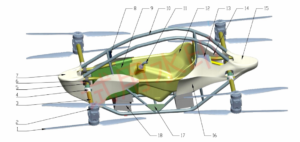 Note:
Note:
- Preparation Work
- Airframe Assembly
- Propulsion System Installation
- Avionics System Installation
- Battery & Power System Installation
- Control System Commissioning
- Final Inspection & Testing
- Safety Precautions
1. Preparation Work
1.1 Tools & Equipment- Electric screwdriver, torque wrench, hex wrench set (Allen keys), wire cutters, multimeter, etc.
- Lifting equipment (e.g., overhead crane), assembly platform, personal protective equipment (PPE).
- Airframe skeleton, rotors (propellers), motors, ESCs (Electronic Speed Controllers), batteries, flight control system, sensors, wiring harnesses, etc.
- Auxiliary materials: screws, nuts, washers, adhesive (thread-locker), cable ties, etc.
| Bill of Materials (BOM) / Parts List | |||
| Category | Item Name | Part Number / Specification | Qty |
| 1 Airframe | |||
| 1.1 Frame | Frame-S100V1.0 | 1 | |
| 1.2 Arm | Arm-Fuselage-S100V1.0 | 2 | |
| Arm-Motor-S100V1.0 | 4 | ||
| 1.3 Arm Fixator | CNC Adapter Set-45/60 | 4 | |
| Screw-M5 * 25 | 32 | ||
| Dowel Pin-M6 * 16 | 4 | ||
| 1.4 Folding Kit | CNC Folding Kit-60 | 4 | |
| Screw-M5*φ6 * 60 | 4 | ||
| Screw-M6 * 30 | 8 | ||
| Screw-M4 * 16 | 16 | ||
| 1.5 Battery Tray | Battery Tray-01 | 2 | |
| Tube Connector Clamp-30 | 12 | ||
| 1.6 Seat | Seat-02 | 1 | |
| 1.7 Seat Belt | Seat Belt | 1 | |
| Screw-M12 | 4 | ||
| 2 Power System | |||
| 2.1 Motor | Motor-24S-H13 | 4 | |
| 2.2 Signal Plug | 3P DuPont Terminal | 8 | |
| 3 Control System | |||
| 3.1 Flight Control | Flight Control-BY AERO (Boying Aviation Technology) 12-28S sp4 | 1 | |
| FC Mounting Box | 1 | ||
| Screw-M4 * 12 | 4 | ||
| 3.2 Coulomb Counter | Shunt Coulomb Counter-High Precision | 1 | |
| 3.3 Remote | Remote-SKYDROID H12 | 1 | |
| 3.4 Joystick | Joystick-smc45 Dual-axis | 1 | |
| 3.5 Wiring Harness | Main Power Harness-S100V1.0 | 1 | |
| 4 Battery System | |||
| 4.1 Battery | Ternary Lithium Battery-Grepow 22000/24S/25C/High Voltage | 4 | |
| 4.2 BMS | Lithium Battery Management System-Silan | 4 | |
| 4.3 Charger | Charger-12KW Li-ion Dedicated | 1 | |
| 5 Passenger System | |||
| 5.1 Helmet | Aviation Sports Helmet-01-XL58/59 | 1 | |
| 5.2 Intercom | Onboard Intercom (Customized) | 1 | |
| 5.3 Protective Gear | Airbag Anti-fall Vest-01-XL175/155 | 1 | |
| 6 Entertainment System | |||
| 6.1 Shell | Shell-Yufei-11 | 1 | |
| 6.2 Display | Display-HUITOWNMA8.4 inch | 1 | |
| 6.3 Camera | Panoramic Camera | 1 | |
| 7 Tools & Materials | |||
| 7.1 Toolbox | Small Toolbox | 1 | |
| 7.2 Threadlocker | Anaerobic Adhesive for Threadlocking | 1 | |
| 7.3 Cable Ties | Nylon Cable Ties | 1 | |
| 7.4 Wire Protector | Wire Protection Sleeve | 4 | |
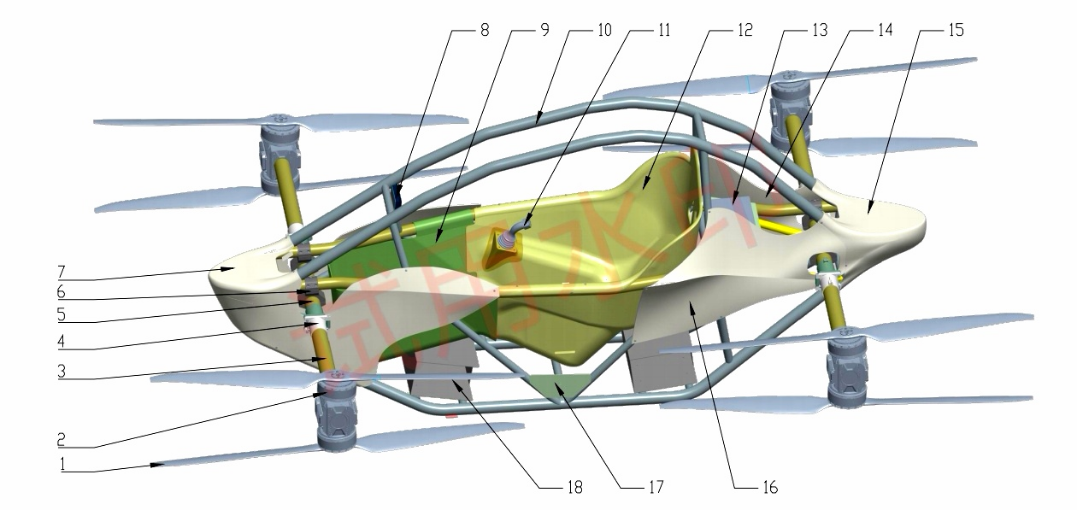 Note:
Note:
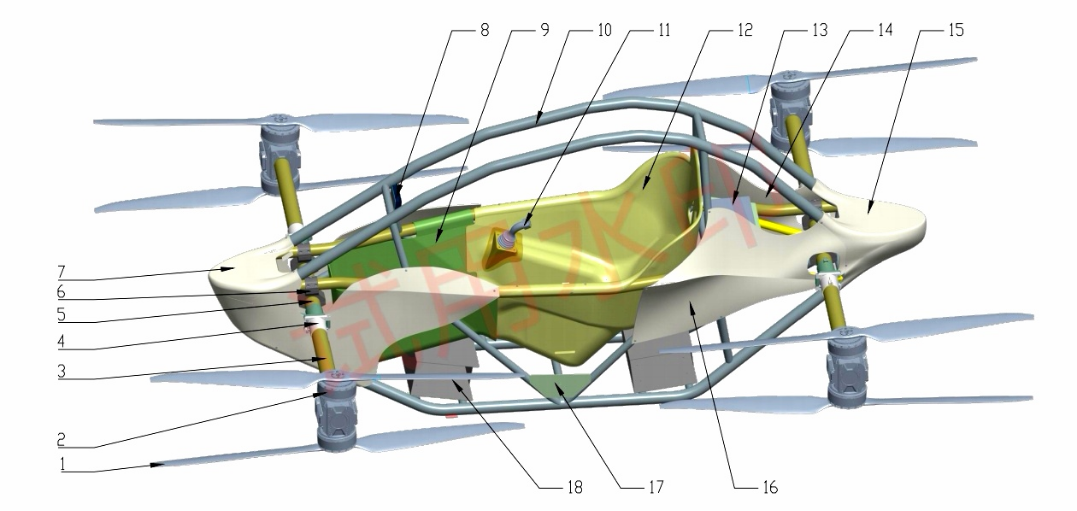
- Propeller
- Motor
- Motor-end Arm
- Folding Component
- Body-end Arm
- Arm Connector
- Nose Cover
- Battery Indicator Display
- Leg Support
- Cage-type Frame
- Control Joystick
- Seat
- Flight Controller
- Rear Right Shell
- Tail Cover
- Rear Left Shell
- Safety Belt Mounting Plate
- Battery :Separate and ship by express delivery [Not packed into wooden box]
- Ensure the work area is clean, tidy, and well-lit.
- Inspect lifting equipment and tools for safety compliance.
2. Airframe Assembly
2.1 Install Airframe Skeleton- Place the main airframe skeleton on the assembly platform, ensuring it is level.
- Secure frame joints using screws and nuts, tightening to the specified torque requirements.
- Align the landing gear with the fuselage mounting points.
- Secure with screws, ensuring the landing gear is stable and level.
3. Propulsion System Installation
3.1 Install Motors- Mount the motors onto the designated positions on the rotor arms.
- Secure the motors with screws, ensuring the motor axis is perpendicular to the rotor arm.
- Install the rotors onto the motor shafts, ensuring correct rotational direction.
- Secure the rotors with nuts, tightening to the specified torque requirements.
- Mount the ESCs inside the fuselage, near the motors.
- Connect the ESCs to the motors, ensuring correct wiring polarity.
4. Avionics System Installation
4.1 Install Flight Control System- Mount the flight control system at the center of the fuselage, ensuring it is level.
- Use vibration-damping pads to fix the flight controller and minimize vibration interference.
- Install sensors including the GPS module, IMU (Inertial Measurement Unit), and barometer.
- Connect sensors to the flight controller, ensuring correct wiring.
- Install the RC receiver and telemetry modules.
- Connect communication modules to the flight controller to ensure normal signal reception.
5. Battery & Power System Installation
5.1 Install Batteries- Secure the batteries in the designated fuselage location, ensuring the center of gravity is balanced.
- Use cable ties or battery mounts to secure the batteries and prevent loosening.
- Connect the batteries to the Power Distribution Board (PDB), ensuring correct polarity.
- Use a multimeter to check voltage and ensure the power system is functioning correctly.
6. Control System Commissioning
6.1 Flight Controller Initialization- Power on the system to boot the flight controller.
- Use Ground Control Station (GCS) software to perform initial setup and configuration.
- Test the rotation direction and RPM of each motor via the GCS software.
- Ensure motor rotation direction is correct and throttle response is normal.
- Calibrate sensors including the Accelerometer, Gyroscope, and Magnetometer.
- Ensure sensor data is accurate and stable.
7. Final Inspection & Testing
7.1 Visual Inspection- Check that all screws and nuts are tightened securely.
- Verify that all cables are secured and free from entanglement.
- Perform ground tests to check all aircraft functions.
- Test communication between the remote controller and the aircraft.
- Conduct a test flight in an open area to evaluate stability and controllability.
- Record flight data for performance analysis and optimization.
8. Safety Precautions
- Wear personal protective equipment (PPE) such as gloves and safety goggles during assembly.
- Ensure the work area is free of debris to prevent tripping or collisions.
- Select an open area for test flights, far away from crowds and buildings.
- Check battery levels before flight to ensure operational safety.
Appendix
- Torque Specification Table: Lists torque requirements for all connection points.
- Wiring Diagram: Provides schematic diagrams for motors, flight controllers, sensors, etc.
- Troubleshooting Guide: Lists common faults and solutions.
Summary
This manual provides the standard assembly process for a 4-rotor eVTOL with a payload capacity of 100 kg class. The process may be adjusted and optimized according to specific models and operational requirements. If further assistance is needed, please feel free to contact us! LAI@YFAIRCRAFT.COM6.Reference for Motor Selection
T-Motor Coaxial Propulsion System Comparison (200kg–600kg+ MTOW Series)
| Model / 型号 | Single-Axis Rated Thrust | Rec. Quad MTOW(Maximum Take-Off Weight) | Rec. Hex MTOW | Voltage / ESC | Prop Size | Tube Diameter | System Weight (per arm) |
| 单轴额定拉力 | 推荐四轴 MTOW | 推荐六轴 MTOW | 电压 / 电调 | 桨尺寸 | 碳管口径 | 系统自重(含桨) | |
| X-A14-24S | 45–50 kg | 180–220 kg | 270–300 kg | 18S/24S · | EFZ57″ (57″) | Ø60 mm | ~9.7 kg/arm |
| (✅ Option 1: 200kg Quad) | (✅ Target 200kg MTOW) | FOC 150A | |||||
| X-A16-24S | 55–60 kg | 220–240 kg | 330–360 kg | 24S · | EFZ63″ (63″) | Ø80 mm | ~11.6 kg/arm |
| (Standard Version) | FOC 260A | ||||||
| X-A16L-24S | 70–75 kg | 280–300 kg | 420–450 kg | 24–28S · | EFZ63″ / | Ø80 mm | ~15.2 kg/arm |
| (High Thrust Version) | (Limit ≈400kg) | FOC 260A | EFZ73″ | ||||
| S150 (HV Direct Drive) | ≈90 kg | ≈360–400 kg | ≈540–600 kg | 400V DC HV Direct Drive | Custom Large Dia. | Custom / On-demand | Varies by config |
| (⚡ Option 2: 400kg Quad) | (@400V HV DC) | (✅ Target 400kg MTOW) | HV ESC (Not compatible with LiPo 24S) | (28″–32″) | (Significantly heavier than X-Series) | ||
| S200 (HV Direct Drive) | ≈125 kg | ≈500–600 kg | ≈750–900 kg | 400V DC HV Direct Drive | Custom XL Dia. | Custom / On-demand | Varies by config |
| (⚡ 600kg+ Heavy Lift) | (@400V HV DC) | HV ESC (Not compatible with LiPo 24S) | (32″–36″) | (Heaviest) |
Logistics Transportation Questions[物流运输]
1.Packaging Method
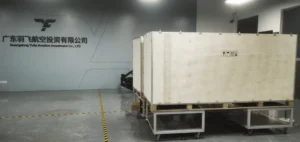
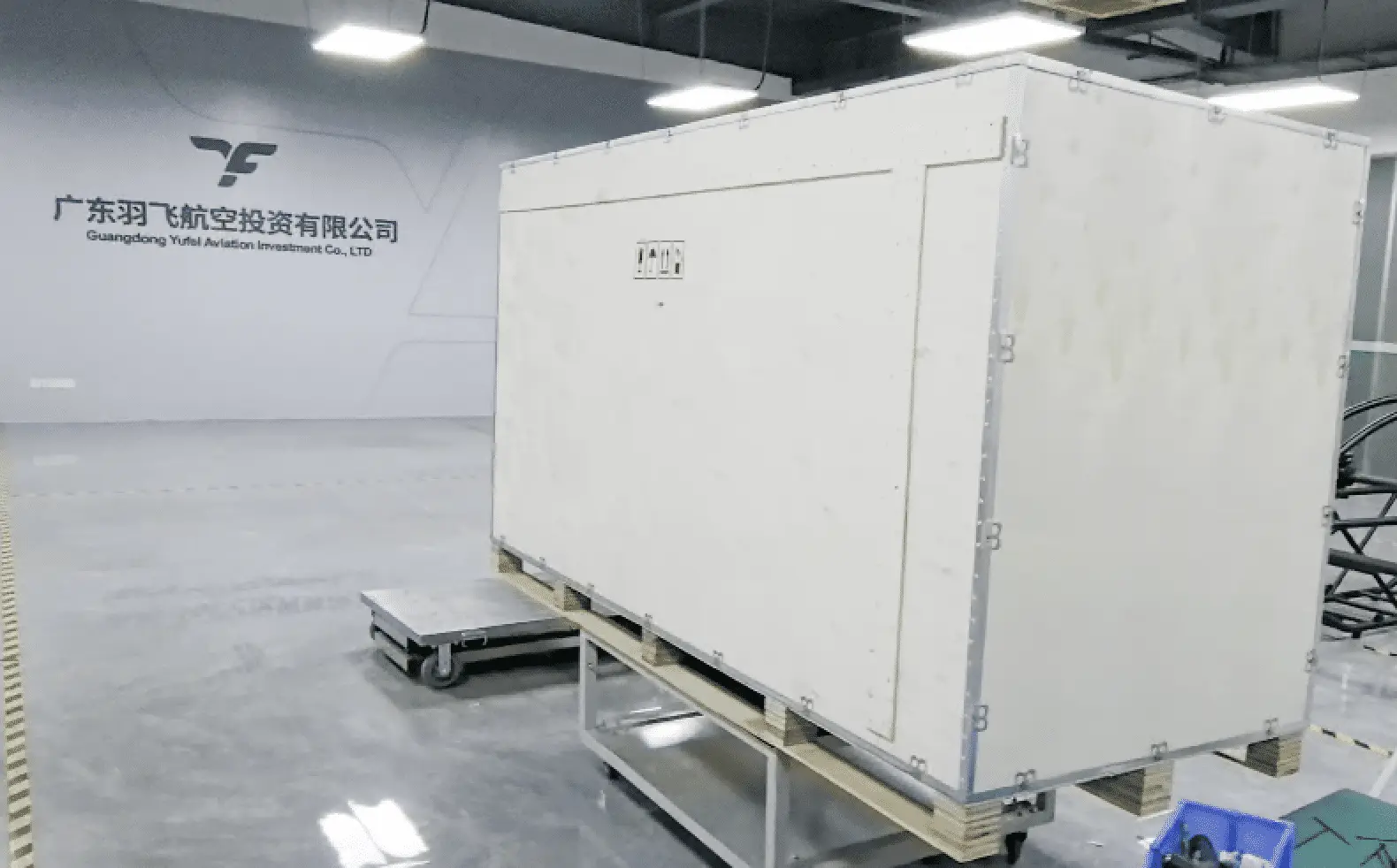
1.All of aircarft 's main frame and folded propeller with motor packaging and fixed by wooden box.
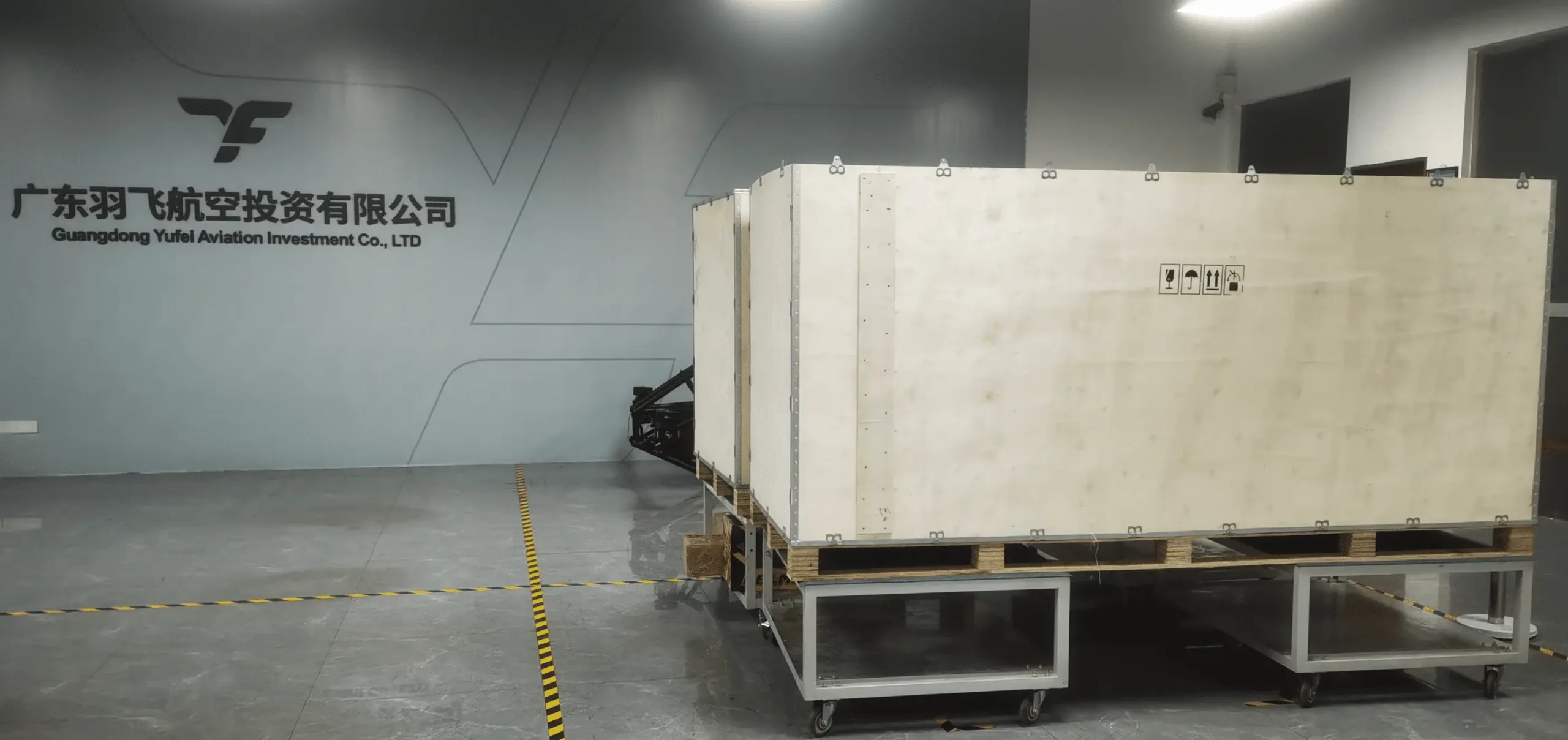
| Item / 项目 | Specification / 规格描述 |
|---|---|
| External Dimensions 外箱尺寸 | 2.7M × 1.2M × 1.3M (L × W × H) |
| Packing Material 包装材质 | Fumigation-exempt Plywood / ISPM 15 Plywood Crate |
| Wood Thickness 板材厚度 | Baseboard & Cover Board: 1.5 CM Vertical Board (Side Panels): 1.0 CM |
2.Logistics Mode
It ships disassembled as TWO parts:
NO.1 Part: Aircraft Frame & foldable carbon fiber support structure fixed four motors, and Independent packaging eight paddles etc. Dominated by sea transportation.
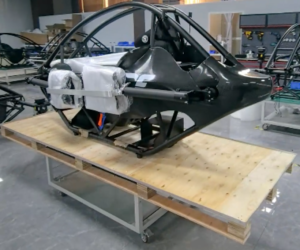
NO.2 Part: Batteries are shipped by air as dangerous goods. Shipping cost is paid by the buyer; door-to-door service is arranged by the freight partner.
NO.1 Part: Aircraft Frame & foldable carbon fiber support structure fixed four motors, and Independent packaging eight paddles etc. Dominated by sea transportation.
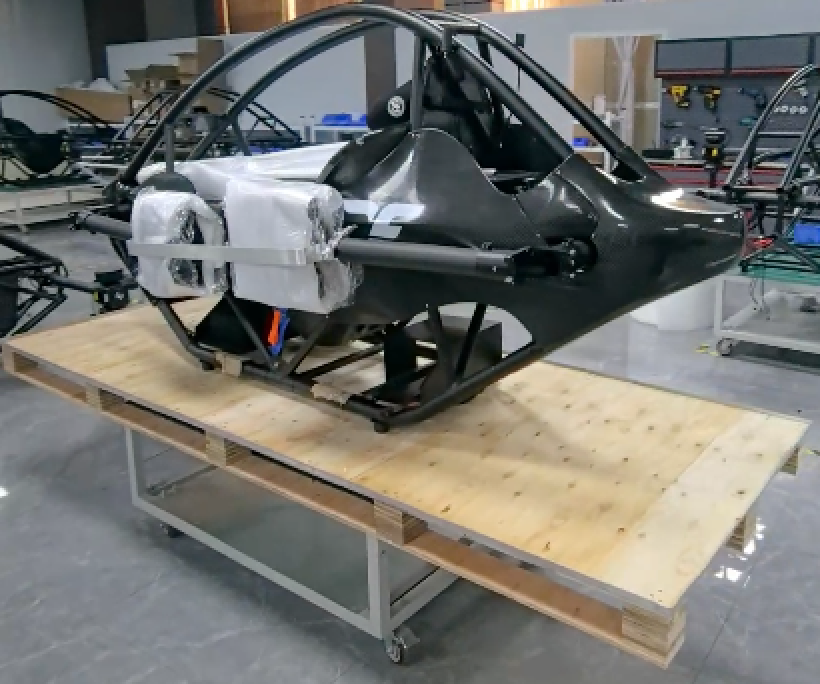
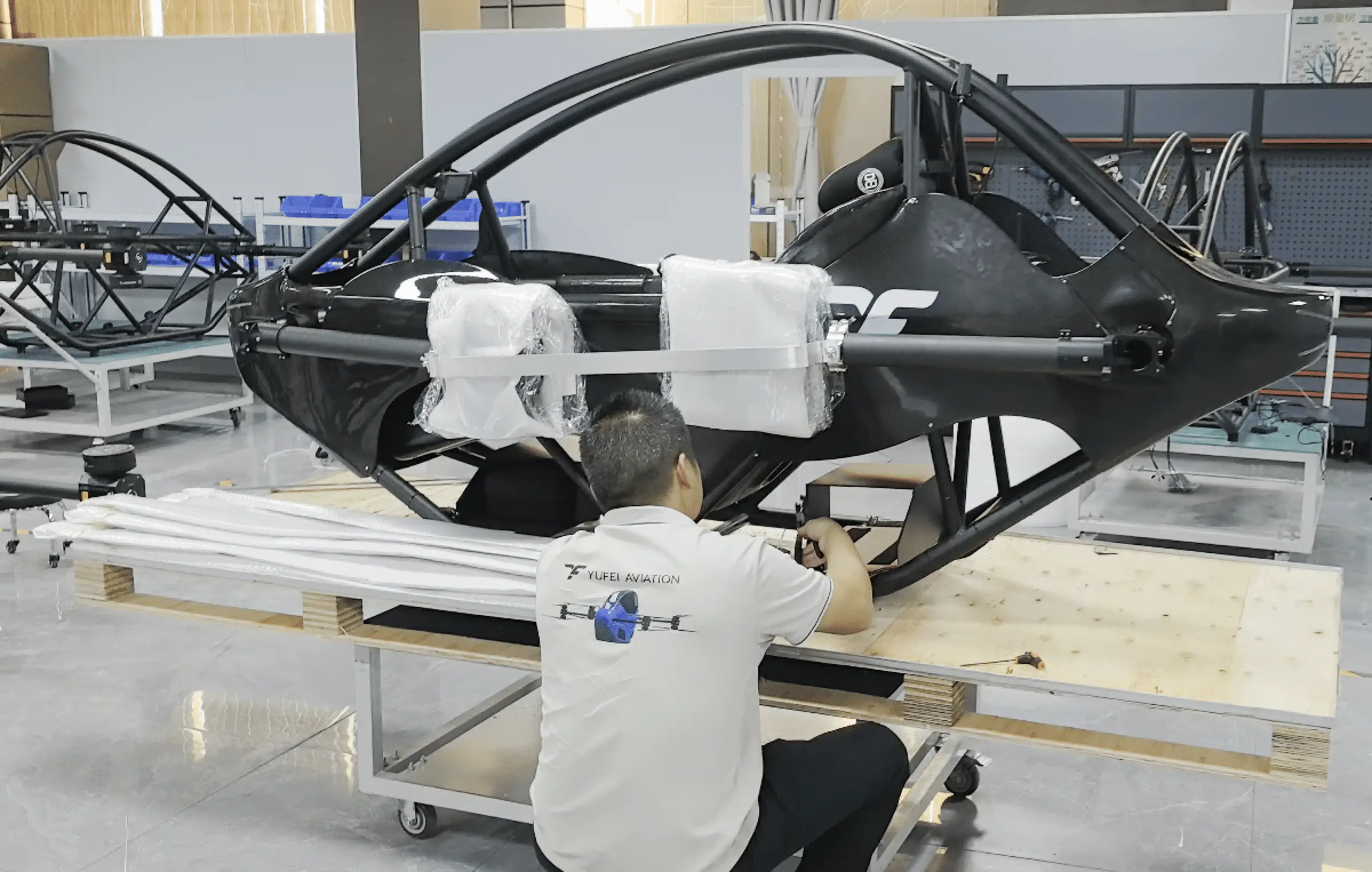
NO.2 Part: Batteries are shipped by air as dangerous goods. Shipping cost is paid by the buyer; door-to-door service is arranged by the freight partner.
3.Checklist For Receiving The Goods
Specific Bill Of Materials (BOM) =【Product Delivery List】 Is As Follows:
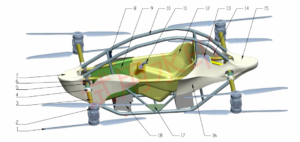
After receiving the all modules , our technical team will provide the remote installation guidance.
Accessories/Upgrade Kits - These will introduce more safety-related, intelligentization-related, competitive-related and application-related accessories to continuously enhance the performance of the aircraft.
| Bill Of Materials (BOM) / Parts List | |||
| Category | Item Name | Part Number / Specification | Qty |
| 1 Airframe | |||
| 1.1 Frame | Frame-S100V1.0 | 1 | |
| 1.2 Arm | Arm-Fuselage-S100V1.0 | 2 | |
| Arm-Motor-S100V1.0 | 4 | ||
| 1.3 Arm Fixator | CNC Adapter Set-45/60 | 4 | |
| Screw-M5 * 25 | 32 | ||
| Dowel Pin-M6 * 16 | 4 | ||
| 1.4 Folding Kit | CNC Folding Kit-60 | 4 | |
| Screw-M5*Φ6 * 60 | 4 | ||
| Screw-M6 * 30 | 8 | ||
| Screw-M4 * 16 | 16 | ||
| 1.5 Battery Tray | Battery Tray-01 | 2 | |
| Tube Connector Clamp-30 | 12 | ||
| 1.6 Seat | Seat-02 | 1 | |
| 1.7 Seat Belt | Seat Belt | 1 | |
| Screw-M12 | 4 | ||
| 2 Power System | |||
| 2.1 Motor | Motor-24S-H13 | 4 | |
| 2.2 Signal Plug | 3P DuPont Terminal | 8 | |
| 3 Control System | |||
| 3.1 Flight Control | Flight Control-BY AERO (Boying Aviation Technology) 12-28S Sp4 | 1 | |
| FC Mounting Box | 1 | ||
| Screw-M4 * 12 | 4 | ||
| 3.2 Coulomb Counter | Shunt Coulomb Counter-High Precision | 1 | |
| 3.3 Remote | Remote-SKYDROID H12 | 1 | |
| 3.4 Joystick | Joystick-Smc45 Dual-Axis | 1 | |
| 3.5 Wiring Harness | Main Power Harness-S100V1.0 | 1 | |
| 4 Battery System | |||
| 4.1 Battery | Ternary Lithium Battery-Grepow 22000/24S/25C/High Voltage | 4 | |
| 4.2 BMS | Lithium Battery Management System-Silan | 4 | |
| 4.3 Charger | Charger-12KW Li-Ion Dedicated | 1 | |
| 5 Passenger System | |||
| 5.1 Helmet | Aviation Sports Helmet-01-XL58/59 | 1 | |
| 5.2 Intercom | Onboard Intercom (Customized) | 1 | |
| 5.3 Protective Gear | Airbag Anti-Fall Vest-01-XL175/155 | 1 | |
| 6 Entertainment System | |||
| 6.1 Shell | Shell-Yufei-11 | 1 | |
| 6.2 Display | Display-HUITOWNMA8.4 Inch | 1 | |
| 6.3 Camera | Panoramic Camera | 1 | |
| 7 Tools & Materials | |||
| 7.1 Toolbox | Small Toolbox | 1 | |
| 7.2 Threadlocker | Anaerobic Adhesive For Threadlocking | 1 | |
| 7.3 Cable Ties | Nylon Cable Ties | 1 | |
| 7.4 Wire Protector | Wire Protection Sleeve | 4 | |
| Category | Item |
| Propulsion | Propeller |
| Motor | |
| Airframe | Motor-End Arm |
| Body-End Arm | |
| Arm Connector | |
| Folding Component | |
| Leg Support | |
| Cage-Type Frame | |
| Nose Cover | |
| Tail Cover | |
| Rear Right Shell | |
| Rear Left Shell | |
| Safety Belt Mounting Plate | |
| Control | Control Joystick |
| Flight Controller | |
| Battery Indicator Display | |
| Interior | Seat |
| Special Note | Battery Not packed into wooden box |
Accessories/Upgrade Kits - These will introduce more safety-related, intelligentization-related, competitive-related and application-related accessories to continuously enhance the performance of the aircraft.
Payment transfer and ordering process [支付打款和订购流程]
1.Visit the Factory For Test Flight.
Welcome to visit our factory for a tour and a test flight experience.
ADD:No. 15 Huagang Avenue Guangzhou Huadu District, Guangdong Province, China.
Guangzhou Baiyun International Airport come to our company plan:
ADD:No. 15 Huagang Avenue Guangzhou Huadu District, Guangdong Province, China.
Guangzhou Baiyun International Airport come to our company plan:
| Comparison Item | Option 1: Metro (Economical) | Option 2: DiDi / Taxi (Direct) | Notes / Tips |
| Total Duration | Approx. 70 minutes | Approx. 40--60 minutes | Metro schedule is punctual; taxis may be delayed by congestion. |
| (Depending on traffic) | |||
| Total Distance | Approx. 27.7 km | Approx. 28--30 km | Routes are largely similar. |
| Estimated Cost | Approx. ¥10–15 | Approx ¥60–90 | Metro is budget-friendly; taxis are cost-effective for groups splitting the fare. |
| (Metro + Bus) | (Excl. highway tolls & night surcharge) | ||
| Transfers / Process | 2 Transfers + Walking | Direct / Door-to-Door | Not recommended for travelers with heavy luggage. |
| 1. T2 B1 -- Line 3 (2 stops) | 1. T2: P8 Parking 2F/3F | ||
| 2. Gaosheng -- Line 9 (10 stops) | 2. T3: P12 Parking 1M/2F | ||
| 3. Feieling -- Bus Hua 102 | 3. Input destination in App | ||
| 4. Walk 300m to destination | 4. Arrive at destination | ||
| Pick-up Point | B1 Level, Terminal 2 | T2: P8 Parking 2F/3F | Ensure you go to the correct pick-up point based on your arrival terminal. |
| T3: P12 Parking 1M/2F | |||
| Payment Method | WeChat/Alipay Transit Code, | DiDi/AMap App Payment, | Prepare a QR code or small change for the metro. |
| Yang Cheng Tong Card | Cash | ||
| Pros & Cons | ✅ Extremely low cost | ✅ Door-to-door service | Choose based on your priority: time vs. budget. |
| ✅ Unaffected by traffic jams | ✅ Comfortable & effortless | ||
| ❌ Multiple transfers & walking | ❌ Possible traffic jams during rush hour | ||
| ❌ Inconvenient for luggage | ❌ 30% night surcharge (23:00---05:00) |
2.Payment method and delivery schedule
A 50% deposit is required at the time of order placement. The remaining balance must be paid in full prior to shipment. Typically, the construction and testing cycle takes approximately 15 days, calculated from the date the deposit is received.
We also maintain stock in certain colors; if no customization is requested, the item can be shipped immediately upon full payment.
1) The contract includes DIY kits for delivery. The assembly is simple and provides assembly videos as well as remote problem consultation services.
2) In the future, overseas and national technical support centers will be established.
We also maintain stock in certain colors; if no customization is requested, the item can be shipped immediately upon full payment.
1) The contract includes DIY kits for delivery. The assembly is simple and provides assembly videos as well as remote problem consultation services.
2) In the future, overseas and national technical support centers will be established.
Pre-Flight Compliance & Safety Regulations matters [飞行前合规事项]
1.Pre-flight compliance instructions
In order to enjoy the safest and most comprehensive flight experience, we strongly recommend that you carefully read the "User Manual" and the "Safe Flight Guide".
Pre-Flight Compliance & Safety Regulations
| No. | Title / Category | Content / Description |
|---|---|---|
| 1 | Safety Guidelines | Flight safety originates primarily from management awareness and strict adherence to operational standards.
Select Flight Environment
|
| 2 | Insurance Coverage | Insurance serves as the ultimate safety net. Before each flight, ensure adequate coverage is in place, including Third-Party Liability Insurance, Personnel Accident Insurance, and Aircraft Hull Insurance. |
| 3 | Regulatory Compliance | All flights must comply with local low-altitude flight regulations and airspace management laws.Understand and comply with the regulations regarding drone flights in your country/region (such as height restrictions, restricted areas, registration, certification requirements, etc.). |
| 4 | Emergency Preparedness | A contingency plan for flight incidents must be established prior to any operation. First-aid equipment must be on-site. A minimum crew of three is required: one Remote Pilot in Command (RPIC), one Visual Observer, and one Safety Officer.Accompanying personnel: Please do not operate the aircraft alone. At least one person should accompany you. In case of an accident, it will be possible to handle it promptly. |
| 5 | Operational Status | At this stage, the aircraft is intended solely for unmanned verification tests and is not approved for manned commercial operations. Conduct three (3) unloaded takeoff and landing tests prior to any flight activity. |
| 6 | Airspace & Separation | Flight activities must be conducted within closed or segregated airspace. Maintain a minimum safety distance of 30 meters between the aircraft and spectators or obstacles. |
| 7 | Altitude & Duration Maintain within visual range | Maximum flight altitude is limited to 10 meters. The optimal safe cruising height is 3 meters. Minimize vertical loiter time to reduce risk exposure. Always keep the drone within your line of sight and at a height of 3 to 5 meters. |
| 8 | Pilot Certification | The operator must hold a valid Medium-Class Beyond Visual Line of Sight (BVLOS) Remote Pilot Certificate and must have passed the manufacturer’s technical driving/piloting training. |
| 9 | Pre-Flight Inspection | Conduct rigorous pre-flight inspections of personnel status, aircraft condition, and environmental factors. Immediately terminate the flight upon identifying any potential risk. |
| 10 | In-Flight Monitoring Environment | Continuously monitor weather conditions, airspace status, and ground personnel during flight. Stay away from crowds and power lines: Do not fly directly above people, and keep away from power lines to avoid accidents.Cease operations immediately and secure all personnel and equipment in the event of high winds, thunderstorms, heavy fog, airspace restrictions, or ground emergencies.Be aware of risks such as strong winds and magnetic interference (such as high-voltage towers, substations). |
| 11 | Maintenance | Proper maintenance and upkeep of the aircraft can significantly reduce the risks to flight safety. |
2.Pre-Flight Safety Checklist
Pre-Flight Safety Checklist
Objective: To ensure the safety of passengers, the aircraft, and the surrounding environment, the following checks must be completed sequentially without exception.| # | Item | Action / Description |
|---|---|---|
| 1 | Pilot Self-Check | Verify that your physical and physiological condition meets the requirements for safe flight operations. |
| 2 | Passenger Weigh-In | Strictly weigh all passengers. Overweight passengers are prohibited from boarding. |
| 3 | Medical History Screening | Interview passengers regarding acute medical conditions to confirm fitness for high-stimulation flight experiences. |
| 4 | Passenger Attire Check | Ensure passengers wear tight-fitting clothing. Prohibited: Loose garments, flowing ribbons, or scarves. |
| 5 | Safety Equipment Check | Verify that the safety harness and aviation helmet are correctly fastened and secured. |
| 6 | Safety Briefing | Remind passengers of safety protocols, specifically instructing them not to extend hands or limbs outside the airframe. |
| 7 | Communication Check | Test the intercom/radio link to ensure normal communication between the onboard passenger and ground control. |
| 8 | Airframe Inspection | Visually inspect the overall structure for damage, cracks, or deformation. |
| 9 | Propulsion & Folding Mechanism | Check propellers, motors, and folding components for tightness and security. |
| 10 | Battery Voltage Check | Verify that battery voltage levels are within the normal operating range. |
| 11 | Takeoff Site Inspection | Ensure the takeoff area is clean and free of debris, specifically lightweight floating objects (plastic bags, ribbons, clothing, ropes). |
| 12 | Crowd Control | Check whether the onlookers are maintaining a safe distance (5 meters) from the aircraft. If not, ask the on-site safety officer for assistance. |
3.Unboxing & Preparation-Check the software and hardware
- Check Contents:Ensure the package includes the drone, remote controller, batteries, propellers, charger, and all specified accessories.
- Charging:Before first use, fully charge the drone battery, the remote controller battery, and your mobile device (phone/tablet).
- Install App:Download and install the corresponding XUAV App on your mobile device (search for it on the Corresponding to the flight control system website).
| Company Name | Profile / Introduction | Official Website |
| Boundary.AI 边界智控 | China's first tri-redundant eVTOL flight control system to enter airworthiness certification. Supplies flight control computers for eVTOL models from Volant, EVTEC, and GAC Research Institute. | https://www.boundaryai.cn/ |
| Aviage Systems 昂际航电 | Joint venture between AVIC and GE Aerospace. Provides eVTOL avionics suites and redundant fly-by-wire systems (LongYu® series). Partners include Aerofugia (Volocity) and LANYI Aircraft. | https://www.aviagesystems.com/ |
| INSKY Lab (Acquired by Zoomlion) 狮尾智能 | Develops airworthy flight control systems for manned eVTOL. Team originated from Honeywell; participates in multiple OEM airworthiness projects. | https://www.inskylab.com/ |
| Xi'an Flight Automatic Control Research Institute (FACRI / 618th Inst.) 航空工业[618所] | AVIC's GNC Center. Develops military/civilian redundant fly-by-wire systems for C919, ARJ21, and select eVTOL platforms. | https://www.facri.com/ |
| Borenth Technology 博伦思智控 | Specializes in medium-to-large UAVs and eVTOL redundant flight control and navigation systems. Focuses on high-reliability applications. | https://www.borenth.com/ |
| JOUAV (Zhongwei) 纵横股份 | Industrial drone manufacturer offering triple-redundant flight control versions. Collaborates on scaled eVTOL verification and technology demonstration. | https://www.jouav.com/ |
| DJI (Da-Jiang Innovations) 大疆创新 DJI | Develops proprietary industrial flight controllers (A3/N3 series) and integrates dedicated autopilots into its agricultural drone platforms (Agras Series). | https://www.dji.com/cn |
| XAG (XAG Technology Co., Ltd.) 极飞科技 XAG | Designs the self-developed XCopilot flight control system with deeply integrated RTK. A global leader in agricultural drones. | https://www.xa.com/ |
| TopXGun (Nanjing TopXGun Robotics) 拓攻机器人 | Specializes in agricultural plant-protection flight control (TG Series), featuring terrain-following and AB-point autonomous operation modes. | https://www.topxgun.com/ |
| EFY Technology (Yifei Intelligence Control) 一飞智控 | Produces Finix-series aviation-grade flight control systems widely used in plant protection, logistics UAVs, and unmanned helicopters. | https://www.efy-tech.org/ |
| JIYI UAV (Shanghai Jiyi Robot) 极翼 | Offers K3A / K++ Pro plant-protection flight controllers with built-in multi-mode agricultural operation algorithms. | https://www.jiyiuav.com/ |
| BY AERO (Boying Aviation Technology) 博鹰通航 | Supplies Paladin-series flight controllers, including RTK-enabled versions tailored for agricultural UAV applications. | http://cloud.byaero.com/ |
| AheadX Technology 致导科技 | Develops self-designed avionics and multi-rotor / VTOL flight control systems; partially applied in agricultural scenarios.Develops self-designed avionics and flight control systems; utilized for composite wing and eVTOL verification projects. | https://www.aheadx.com/ |
| CUAV (Guangzhou Cuav Tech.) 雷迅创新 | Manufacturer of Pixhawk-compatible open-source flight controller hardware (Pixhawk V6X, X7+ Pro); adopted by some agricultural UAV integrators. | https://www.cuav.net/ |
| Yingfei Technology (YF GCS) 影飞科技 | Manufacturer of the KFC300 series industrial flight control systems. Designed for agricultural plant protection and VTOL (Vertical Take-Off and Landing) UAV applications. | https://www.yfgcs.com/ |
| XY-UAV (Xiangyi Hengchang) 翔仪恒昌 | Produces KFC-series industrial fixed-wing and multi-rotor flight control computers for composite-wing UAVs and research verification. | http://www.xy-uav.com/ |
| Borenth / i-Balance (Beijing Chuangheng Control) 创衡控制 | Designs military/industrial-grade redundant flight control systems; used in certain industrial and plant-protection UAV verification projects. | https://www.i-balance.cn/ |
- Install Propellers:Note that propellers are directional (usually marked, e.g., CCW for Counter-Clockwise). Apply the provided thread-locker (screw glue) and tighten securely (Torque: 9.5 N·m).
4.Equipment connection and calibration
Pre-Flight Preparation
1. Hardware Setup- Unfold the drone arms and tighten the folding mechanism screws.
- Install the propellers securely.
- Power on the remote controller and connect your mobile device to it.
- Insert the drone battery. Place the drone on a flat, level surface with the tail facing towards you.
- Compass Calibration: Perform calibration if prompted by the App or if you have changed flight locations. Follow the on-screen instructions (typically rotating the drone horizontally, then vertically).
- IMU Calibration: Usually not required unless an error message appears. If calibration is needed, ensure the drone is placed on a perfectly level surface and follow the App instructions strictly.
5.Test controller and aircraft’s sensitivity.
Wait for Positioning
After powering on, wait for the drone to acquire sufficient GPS satellites. The App interface should display "RTK Fixed" with 25+ satellites locked in to ensure stable hovering.
Takeoff
- One-Key Takeoff: Locate the "One-Key Takeoff" button on the App interface. Slide the confirmation bar, and the drone will automatically take off and hover at approximately 2 meters.
- Manual Takeoff: Alternatively, perform the "Inner Eight" stick command (simultaneously push both sticks down and inward) to start the motors. Then, slowly push the left stick upward to lift off.
- Left Stick (Up/Down): Throttle (Ascend / Descend)
- Left Stick (Left/Right): Yaw (Rotate nose left / right)
- Right Stick (Up/Down): Pitch (Move forward / backward)
- Right Stick (Left/Right): Roll (Move left / right)
- Smart RTH: Tap the Return to Home icon on the App interface. The drone will automatically return to the recorded takeoff point and land.
- Remote Controller RTH Button: Press and hold the RTH button on the remote controller until the buzzer sounds.
6.After NO.5 test is completed, please record 《the aircraft inspection form》 prepare for frequent flights.【The most important summary report】
After NO 5--the test is completed, please fill out the aircraft inspection form. This is to prepare for frequent flights
【The most crucial and important summary report】
| Item / Check Point | Status |
| 1. Hardware Inspection | |
| Frame without cracks | |
| Arms without breaks/fractures | |
| Seats without damage | |
| Safety belts without breaks | |
| Shell/Casing without damage | |
| 2. Power System | |
| Motor temperature (Within 90°C) | |
| ESC temperature (Within 90°C) | |
| ESC indicator lights normal | |
| Propeller surface intact, screws tight | |
| Folding mechanism without looseness | |
| 3. Control System | |
| Heading positioning accurate | |
| LED indicators normal | |
| No error messages | |
| Remote controller battery > 50% | |
| Remote controller APP normal | |
| Joysticks normal | |
| Camera normal | |
| 4. Battery System | |
| Battery level > 50% | |
| Temperature < 60°C | |
| Battery pack voltage difference ≤ 0.5V | |
| 5. Passenger System | |
| Helmet worn | |
| Intercom functional | |
| Airbag anti-fall vest worn |
7.Precautions for manned flights
Low-Altitude Flight Experience – Passenger Guidelines
To ensure your safety and enjoyment, please strictly adhere to the following guidelines before, during, and after the flight.I. Pre-Flight Preparation
1. Physical Health Condition- Basic Requirements: Passengers must not suffer from heart disease, hypertension, severe acrophobia (fear of heights), recent major surgery, epilepsy, etc. Pregnant women are strongly discouraged from flying.
- Mental State: Ensure adequate sleep before the flight. Avoid flying under conditions of extreme fatigue, intoxication, or after taking medication that impairs mental alertness.
- Communication Ability: Passengers must be able to communicate clearly and effectively with the pilot.
- Clothing: Wear lightweight, warm, casual sportswear. Avoid skirts and excessively loose clothing to prevent entanglement. Layered clothing is recommended depending on season and altitude.
- Footwear: Closed-toe athletic shoes or hiking boots are mandatory. Flip-flops, sandals, and high heels are strictly prohibited.
- Sun Protection: UV rays are intense at altitude. Apply sunscreen and wear sunglasses (preferably with a retainer strap to prevent loss).
- Personal Belongings: Before takeoff, securely store all small items (mobile phones, cameras, wallets, keys, etc.). Items can be handed to ground staff or placed in designated secure pockets (ensure zippers are closed). Absolutely no handheld items are allowed during flight to prevent dropping.
- Trust the Pilot: Your pilot is professionally trained and certified. Please trust their judgment and skills implicitly.
- Takeoff & Landing: Expect brief vibrations during takeoff and landing; do not panic.
- In-Flight: While generally smooth, minor turbulence caused by air currents may occur. This is normal—remain relaxed.
II. During the Flight
1. Follow Instructions- Absolute Compliance: You must follow the pilot’s instructions completely throughout the flight. The pilot is the sole commander of this operation.
- Takeoff & Landing:
- Takeoff:Upon hearing "Ready for takeoff," relax and prepare for liftoff.
- Landing:Remain seated until the aircraft is fully grounded and all propellers have stopped.
- In-Air Conduct: Do not extend hands outside the cockpit. Do not unfasten your seatbelt or helmet without permission.
- Photography & Video: If using a phone or camera, ensure it is tethered to your wrist or neck with a lanyard and only operate it during stable flight phases.
- Body Movement: Maintain a stable seated posture. Avoid sudden, large movements (e.g., violent twisting, shaking), as this affects flight balance.
- Communication: The pilot will communicate via the intercom system in your helmet. You may ask questions or report discomfort, but please keep communications concise to avoid distracting the pilot.
III. Post-Flight
- Only after the pilot confirms the aircraft is fully stationary may you release the safety buckle and exit the aircraft under guidance.
- Retrieve your personal belongings and check for any lost items.
- Feedback is welcome—please share your opinions or suggestions with the operations team.
IV. Important Disclaimers & Safety Statements
- Pilot Authority (Weather): The pilot holds absolute authority regarding flight decisions. Decisions regarding whether to fly, when to take off, when to return, or whether to alter/cancel the flight are made solely by the pilot based on real-time weather (wind speed/direction, visibility, cloud cover) and safety conditions. Even if payment has been made, please understand and cooperate if flights are canceled due to weather.
- Safety Liability: Any safety incident resulting from the passenger’s failure to comply with these guidelines (e.g., disobeying instructions, concealing medical conditions, unauthorized operation) shall be the passenger’s sole responsibility.
- Insurance: All legitimate operators provide aviation accident insurance for passengers. Please confirm insurance arrangements before the flight.
V. Quick Process Summary
| Step | Action |
|---|---|
| 1. Arrival | Sign in, confirm physical condition, weigh-in, sign safety waiver. |
| 2. Preparation | Store belongings, gear up (helmet/harness), listen to pilot briefing. |
| 3. Takeoff | Follow commands until liftoff. |
| 4. Flight | Relax and enjoy the view, follow commands, take stable photos. |
| 5. Landing | Follow commands until the aircraft is fully stopped. |
| 6. Completion | Remove gear, retrieve belongings, share your experience. |
8.How is flight safety ensured?
1) From the perspective of manned safe flight, we suggest that the safe flight altitude at ultra-low altitude should be 3-5 meters; and we recommend gliding flight to avoid prolonged vertical take-off and landing;
2) Battery redundancy: A single battery of the aircraft can support the take-off and landing of the aircraft;
3) Power redundancy: The power redundancy mechanism of the aircraft can ensure safe take-off and landing in the case where one motor of each of the four arms fails;
4) In the event of a sudden generator failure and vertical drop, the main safety mechanisms include: The fuselage is in a racing car cage-like structure, effectively protecting personal safety; The seat is made of suspended carbon fiber material, which can absorb 70% of the impact force; Finally, wearing protective clothing, even if there is a failure, the person will not suffer serious injuries.
2) Battery redundancy: A single battery of the aircraft can support the take-off and landing of the aircraft;
3) Power redundancy: The power redundancy mechanism of the aircraft can ensure safe take-off and landing in the case where one motor of each of the four arms fails;
4) In the event of a sudden generator failure and vertical drop, the main safety mechanisms include: The fuselage is in a racing car cage-like structure, effectively protecting personal safety; The seat is made of suspended carbon fiber material, which can absorb 70% of the impact force; Finally, wearing protective clothing, even if there is a failure, the person will not suffer serious injuries.
9.Purchase Of Insurance
To ensure the healthy development of low-altitude flight activities, participants are strongly advised to purchase insurance for safety protection. Flight sports insurance is mainly divided into three categories: site third-party liability insurance, aircraft passenger and pilot insurance, and aircraft property insurance. Currently, there are corresponding insurance companies providing support for these three types. Overseas, the specific coverage depends on the country.